Showing posts with label Racism. Show all posts

Friday, March 23, 2018

Stephon Clark, guns, and feelings that aren't facts

On Sunday, Sacramento police officers killed Stephon Clark in his own backyard. He was unarmed. They shot him 20 times. Afterwards, police said they "felt he had a weapon" and that they "feared for their safety." No explanation -- and certainly no blog post -- will make this ok. Not for Mr. Clark. Not for his family and friends. Not for his children. Not for our society. My heart is breaking, again, today.

When I was in the hospital during the period of mental health crisis I write about in my book, there was an adage that several people shared with me:

"Feelings aren't facts."


The idea was that, while the feelings I was having -- feelings of isolation, of self-hatred, of suicidal ideation, of devastation, of fear -- felt very real to me, they weren't necessarily accurate representations of the reality around me.

This was a really difficult thing to process, and still is. At times, it makes me doubt myself, doubt my own sense of things, my own instincts.

It's also a statement that bears some helpful critique. Your feelings aren't facts, but the fact that you are feeling them matters, should not be harmfully dismissed, and probably has some good data for you about what's going on internally and in your environment.

Still, there is important truth in the statement. "Feelings aren't facts." My feelings weren't factual. I wasn't really alone. I wasn't really a horrible human being. The world wouldn't really have been better off without me.

And as long as those feelings were leading me to be a danger to myself -- which, to be clear, they indeed were -- the right thing for me to do was to be in a safe place, under the care of people who could help keep me safe, while I (with lots of help) got my brain back to a place where it could accurately perceive reality.

Feelings aren't always facts. And when our feelings make us dangerous -- dangerous in the sense of "prone to causing actual physical harmd" -- to ourselves and others, then we need to learn to recognize that, and be somewhere safe.

And definitely not have access to a gun.

Even, and especially, a state-sanctioned gun.

Sacramento police say they "felt" Stephon Clark had a gun. They say they "feared for their safety" from a man with a cell phone in his own backyard.

But feelings aren't facts. That's what I learned on the psych ward.

And if you don't know how to manage your feelings, to the extent that they lead you to kill somebody, you need to be somewhere where you can't hurt anybody. And you definitely shouldn't have a gun.

The "feeling" that Stephon Clark had a gun was wrong. It was inaccurate. The feeling of fear for their safety was not an accurate reflection of reality. Their feelings were not facts.

Of course, going along with the story that the police "felt" Stephon was a threat or had a gun conceals more than it reveals. Stephon was a black man. The "feeling" that someone is a threat to you needs to be interrogated. Is this "feeling" actually racism? Bias? The way that implicit bias, not to mention overt and systemic racism, affect the behavior of armed police officers toward African Americans in this country continues to be revealed, in ugly and violent ways, over and over again. And it will keep doing so until we do something, actually a lot of things, about it.

Here's one thing we could do: hold police officers to the same damn standard I was held to when I was in the psych ward.

Feelings aren't facts. And if your feelings are going to get someone, yourself or someone else, killed, it's time for you to be under care, in a place where harm can be minimized.

And certainly not carrying a gun around.

Even -- and perhaps, because of the power and the sense of authority it gives you, especially -- if you're carrying that gun on behalf of the state.

Feelings aren't facts. Not for me. Not for Sacramento police officers. Feelings aren't facts. But the fact of the matter is, unmanaged and unhandled, feelings can kill.

So: will we decide to hold police accountable for the potentially deadly results of their "feelings"? It's the standard I, someone with a mental illness, will be held to for the rest of my lives. Shouldn't it be a minimum standard for police officers, as well?

And if you're going to tell me my feelings aren't facts when I'm suffering, you better not be giving cops a pass for killing an unarmed man because they "felt" he had a gun. 

Wednesday, February 28, 2018

Institutions, Care, and Better Conversations

Do we need more mental healthcare institutions?

A 1900s photo of St. Elizabeths Hospital in DC
This question has entered the national discussion after the horrific shooting in Parkland, Florida. I've written in far-too-great length (at least for a blog) about the problem with associating mass violence with mental illness -- here's Part I and Part II of "Mental Illness Isn't Violence (But Our Systems Sure Are Sick)." But the discussion around institutionalization is close to my heart -- my book, which will be released next month, largely revolves around my own experiences with psychiatric hospitalization -- and I thought it would be worth sharing a few quick points about it:

-- Deinstitutionalization began in the 60s and 70s as a response to civil rights and mental health advocates who spoke out against institutional abuse and neglect. The idea was to close big institutions, which were horrendous and often served not so much as health care centers as prisons for folks who didn't "fit," and replace them with community mental health centers. These centers would be smaller, more localized, and more integrated into communities, allowing for people with mental illnesses to remain connected to other sources of support such as families, faith communities, friends, and other community services.

-- During the 80s, community mental health centers fell victim to tax cuts and lack of funding. Rather than transitioning from big, awful institutions to smaller, community-based centers, we went from institutions to not much of anything at all. Many advocates trace the modern realities of homelessness in this country to this period.

-- Currently, there is a massive shortage of psychiatric beds in this country. According to a report by the Treatment Advocacy Center, in 2010 there were only about 14 beds available for every 100,000 people in this country.

An image from the Treatment Advocacy Center's "A Bed Instead" campaign

-- This shortage, among other factors, means that hospital emergency rooms, prisons, and homelessness have effectively taken the place of psychiatric hospitalization for many people experiencing serious mental illness.

-- Like everything else in this country, this reality is further impacted by racial and socioeconomic factors. Who gets a bed, and who ends up in prison, is affected by intersecting and oppressive systems.

-- We need more psychiatric beds, but not because mental illness is predictive of violence. As I've written about previously, those with mental illnesses are much more likely to be victims of violence in this country, and if we want to have conversations around the mental health implications of mass violence, we need to take a systems approach that considers factors such as toxic masculinity, white supremacy, cultures of violence, and access to guns.

-- We need more and better mental health care facilities, but this administration's rhetoric on the matter is stigmatizing, reactionary, and harmful. It ought to go without saying, but of course it doesn't these days, that saying we need more institutions to deal with "sickos" demonizes and scapegoats people with mental illnesses.

-- We need more and better care options for folks with mental illness because folks with mental illness are people who deserve care, compassion, and health. 

There is more to say on the matter from a policy perspective, but these are at least a few framing points for the conversation, centering it where it should be centered -- actual, effective, compassionate care -- rather than as a reactionary conversation that equates mental illness with violent crimes.

Let me wrap this up with a few words about my own experience with psychiatric hospitalization/institutionalization.

If you want more than a few words, I know where you can find them.
First of all, my experience was a privileged one. I had access to quality care, and to people who knew how to connect me to quality care, which are not realities that can be taken for granted by most people in the U.S. I also had a level of awareness of my own need for help, both because of conversations within my family about mental illness and also because of the nature of my illness. My racial identity, socioeconomic background, and other factors allowed me a level of access that is often denied to people in this country who are impacted by multiple oppressions. And still, in spite of all of this, psychiatric hospitalization felt scary, and isolating, and out of my control. I am very grateful for the hospitals that kept me safe and gave me space to stabilize and start on the path toward healing; and also, conversations around psychiatric hospitalization -- and even more so long-term institutionalization -- should be approached with a great deal of care, compassion, and nuance.

On a second, and related, note: we can't talk about "bringing institutions back" without acknowledging the fact that the prison system is standing in for an actual mental care system in this country. When I was discharged from a longer-term stay at a hospital in Connecticut, I returned to the DC area and began working with a therapy group using an approach called Dialectical Behavior Therapy. When I first met with the psychologist who ran the group, she shared with me that it was relatively rare for her to have men in her groups.

"Why is that?," I asked.

"Because men with your diagnoses usually end up in prison first," she said.

So if we're going to talk about the past abuses of institutions, we also need to be talking about the current abuses of our nation's de facto biggest mental health care institution -- the prison system -- not to mention the complete lack of institutional support faced by those experiencing homelessness. (I wrote more about this latter reality recently).

#EndTheStigma
Finally, my experience of hospitalization looked nothing like the popular perception of such a thing, which in my own pre-hospitalization experience was a mishmash of One Flew Over the Cuckoo's Nest-esque images of straitjackets and dictatorial nursing staff. You can read a whole heck of a lot more about my experience in my book (did I mention it's coming out next month?). Suffice to say I think it's really important that we de-stigmatize psychiatric hospitalization. It saved my life. At the same time, we need to acknowledge the history of institutional abuse and neglect and be very careful that our approach to mental healthcare institutions is focused on compassionate and effective care. Reactionary, stigmatizing rhetoric will not produce this.


Psychiatric hospitalization saved my life. It deserves to be talked about. We do need more, better mental health care institutions. And the importance of these institutions deserves a conversation focused on compassion, care, and effective treatment, not on blaming and scapegoating people with mental illnesses.

Monday, November 6, 2017

Mental Illness Isn't Violence (But Our Systems Sure Are Sick), Pt. II

This is the second part of a two-part post. Part I looks at the inaccurate public perception of a connection between mental illness and mass violence. Part II looks more closely at systems.Even as I share this post, I am mindful of the fact that for those directly affected by violence, no think piece and no blog post can address the pain they are going through. For a lot of people, the world feels like it has ended right now. Let's try to honor that with our words, our reflection, and our action. 

I Wish I Wasn't Writing This

I wish part II of this blog post wasn't so relevant.

I wish, I really wish, that there hadn't been another horrific mass shooting.

I wish, I really wish, that it didn't fall so closely on the heels of another horrific act of violence, and that there weren't such easy comparisons to make between the response to the former and the response to the latter.

That the latter is "sad" and "a mental health problem" while the former was "ISIS-inspired" and led to more calls to close the borders.

So clearly illustrating that when the killer is a white man, we scapegoat mental illness, and when the killer is a Muslim man, we scapegoat Islam, or immigrants, or both.

But the scapegoating and the individual pathologizing won't help, it won't stop this, and it will just lead to more hurt and more violence against already marginalized people.

Here's how I concluded my last post:
If we want to talk about violence as form of illness, a form of dis-ease, that's fine. Let's talk about it. It's just that mental illness, which deals with an individual's struggle with experiences that prevent them from functioning the way they want to function, is exactly the wrong category for such a naming. Rather, violence represents a systemic un-health, an interaction between an individual and larger forces that are harmful, that are in-and-of-themselves violent. Paul called them "the powers and principalities." Such unhealthy systems do very much impact our health, mental, physical, emotional, and spiritual. But that doesn't mean they can be diagnosed by pathologizing an individual's violent actions. Mental illness isn't violence. But violence might well be an illness, and a systemic one at that. We've got some very sick systems that we're operating in and amongst, and perhaps they are indeed in need of diagnoses. 
So, let's talk about systems. And if it seems to soon to talk about this in the wake of the shootings in Sutherland, TX, that's ok. Just assume this is a belated post about Manhattan. Or Las Vegas. Or...God dammit, really, sincerely: God damn the lengthy, blood soaked list. Let's talk about it now.

What We're Talking About When We Talk About Systems

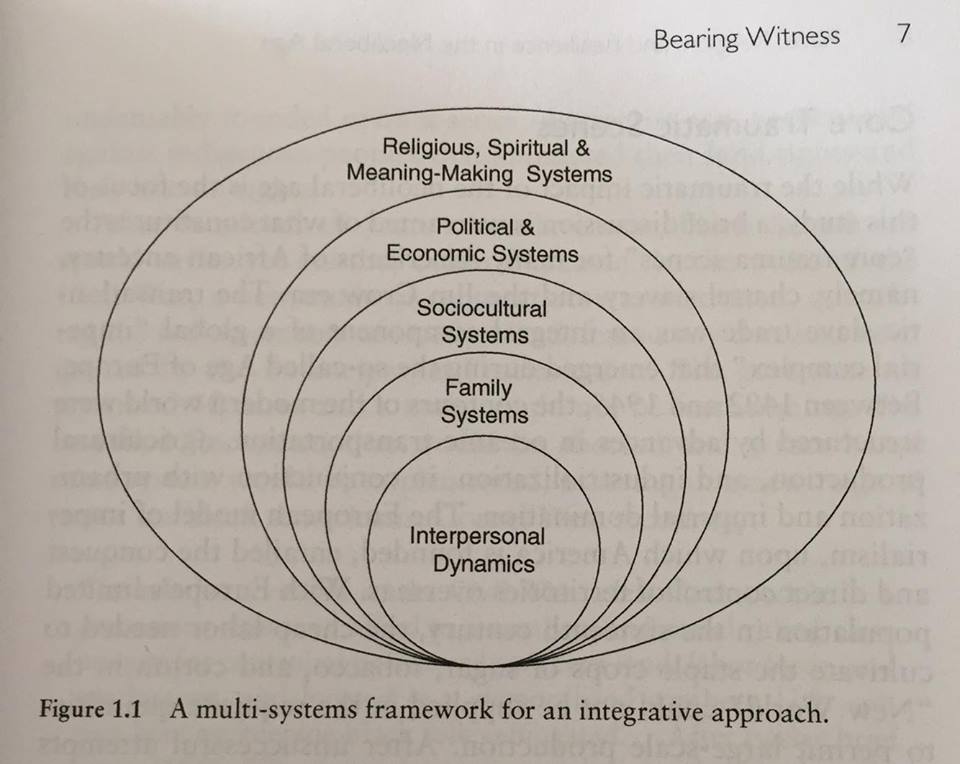
Dr. Cedric C. Johnson, in his book Race, Religion, and Resilience in the Neoliberal Age, writes about an "integrative approach" to soul care:
An integrative approach argues that understanding human functioning is not possible without comprehending the context in which it is formed as a subsystem within a matrix of interlocking historically situated systems. It entails assessing interpersonal dynamics, family systems, sociocultural systems outside the family, economic and political systems, as well as religious, spiritual, or other meaning-making systems. An integrative approach considers the potential influence these systems may have on those who come for care. It thus requires one to "think systems" at all times, even if the practitioner of care is seeing only one member of a family. Strategies for care are derived from an ongoing assessment of where and how to intervene, whether the practitioner is addressing interpersonal dynamics, family dynamics, or the larger systems within which the person or group exists (pg. 6).
Maybe that seems like a lot. Never fear! Dr. Johnson provides a helpful graphic:

From Race, Religion, and Resilience in the Neoliberal Age, pg. 7
The behaviors, strengths, and pathologies of an individual are impacted by the multiple systems they operate in, and vice versa.

This, by the way, is true even for folks who really do have a diagnosable mental illness. Here's John Swinton writing in his book Resurrecting the Person: Friendship and the Care of People with Mental Health Problems:
Mental health problems are incredibly complex phenomena that occur to human beings, who are themselves highly complex creatures. Because of this, there can be no such thing as schizophrenia, bipolar disorder, depression, or any other form of mental health problem, apart from the person who is experiencing it....Likewise, there can be no such thing as a person apart from the particular communities within which the person exists.....Mental health problems, rather than being definable in terms of biology or diagnosis, are an ultimately indefinable combination of pathology, personhood, and community; the aspects are inextricably interlinked. If we omit one from our caring equation, we risk misunderstanding the others (pg. 27).
In other words, even for folks who do indeed have a diagnosable mental health challenge, the diagnosis is only one aspect of a complex human, in community, impacted by systems. We can't just say, "X person had a mental illness" as if that explains their behavior or their personhood. It's an oversimplification, and an ineffective and stigmatizing one at that.

So when we're talking about systems, we're talking about the relationships, communities, and broader forces that impact (and are impacted by) the actions of individuals.

Sick Systems

So what are some of the systems whose sickness I think we should be diagnosing in order to prevent horrific acts of mass violence in this country?

Sick systems, not a sick person

Here is a by-no-means complete list:

Toxic Masculinity
The vast majority of acts of mass violence in this country (and, I would venture to guess, throughout the whole damn history of the whole damn globe) are committed by men. Men, particularly white men, commit the majority of mass shootings in the U.S. (here's one source on that). There's a strong correlation between men who commit acts of mass violence and a previous history of domestic violence or abuse against women (again, here's just one source on that). Why? Here's my friend Jay Yoder, writing a month ago:
Masculinity is all the ideas about what being a man means that we’ve decided as a culture are true and important and necessary. So: being a man means being strong, violent, aggressive. Being a man means being in charge. Etc. etc. etc. ....When we demand certain things of someone because of what gender we need them to be, and in the case of manhood, when we punish it with ridicule, shame, violence, degradation, humiliation (see frat rituals, team rituals, etc.), it creates a toxic masculinity that is bound up in and enforced by violence.
When we teach men, and before that, when we teach young boys, that being a man means being dominant, aggressive, and in control, this has consequences. When those young boys grow into men and find out that they can't, in fact, always be strong, always be in control, always win, this has consequences. Violent consequences.

White Supremacy, Race, and Racism
As already noted, mass shootings in the U.S. correlate not just with masculinity but, more often than not, with white masculinity. I've already written about white supremacy and violence after being in Charlottesville in August. My friend Alicia Crosby offers this definition of white supremacy, which stretches beyond the overt white nationalism of neo-Nazis and KKK members:
White supremacy establishes whiteness as superior to other racial identities through the elevation of the needs, wants, concerns, perspectives, feelings, and desires of white people over that of people of color. This includes the centering of the theological, rhetorical, aesthetic, and economic priorities and preferences rooted in whiteness as well as the appropriation and rebranding of cultural expressions sourced from people of color.
To this, I'd add that white supremacy teaches white people that we deserve to succeed, that we deserve to be in charge, that we are supposed to be the most successful and most important and the peak of civilization.

And then we aren't.

Then we fail at things, and we lose jobs, and we mess things up, and we're sort of mediocre most of the time just like most other people are, and because we've been taught (often subconsciously, sometimes overtly) that by virtue of the color of our skins we are supposed to be superior, and we don't feel very superior at all, we experience this unnamed type of shame. Stir that in with toxic masculinity and violence very quickly becomes a way to re-assert this felt need for control, for success, for extra-ordinary-ness, that is falsely promised to us by white supremacy. Which makes young white men susceptible not only to individual acts of violence, but to intentional radicalization and recruitment.

Radicalization and Recruitment in the Neoliberal Age
Here's just one article (from Vox) about the radicalization of white Americans, about how many of the people who are radicalized are perceived as, and experience themselves as, "losers," and how certain extremist groups can take advantage of that. After Charlottesville, my friend Julie Norman wrote in the Washington Post about her research on youth radicalization, drawing connections between her research with youth in the Middle East and North Africa and the Charlottesville attack. Julie and her research collaborator Drew Mikhael wrote:
From our focus groups, youths who were the most susceptible to radical messaging were those who perceived themselves to be politically and/or economically marginalized, resulting in a pervasive sense of purposelessness and lack of hope for the future. However, it was not poor socio-economic status itself that pointed toward susceptibility, but rather a sense of relative deprivation, coupled with feelings of political and/or social exclusion.
So if you've been told that you're supposed to be in control, and successful, and in charge, but instead you feel excluded, or like a failure, or like a loser...well, it's that much easier for you to radicalize yourself on the internet, or to be intentionally radicalized by a particular organization. The folks who are most susceptible to this are the cast-offs of the neoliberal age, the ones who have been promised much but offered little. And so they go looking for something that can provide them meaning, purpose, a sense of superiority or at least of value. Julie and Drew again:
Ideology matters, but not necessarily its core messaging, be it Islamic fundamentalism or white supremacy. Rather, radical groups use religion and ideologies to legitimize grievances, placing themselves as agents of change and promising empowerment and a sense of purpose.
And if you're looking for meaning and purpose and power, in this culture, there's no promise no alluring than the meaning-making power of violence.

A Culture of Violence, or, Violence as Meaning-Making System
Remember Dr. Johnson's handy diagram? The largest circle in the multi-systems model is "Religious, Spiritual, and Meaning-Making Systems." Ideologies such as white supremacy can fill this role; but I'd argue that in our country, violence itself functions as a meaning-making system. We could talk about theologian Walter Wink's work on "redemptive violence" here, or Chris Hedges' excellent book War is a Force that Gives Us Meaning, or any number of other pieces. We could talk here about an entertainment industry that relies on portrayals of violence to make sales. In a culture of violence, enactments of violence promise meaning, purpose, and power, obscuring the fact that violence gives none of those things. It just gives injury and death.

Gun Companies and War Profiteering
Of course, all of these factors are exacerbated and made more deadly by the ready availability of guns. Groups like Moms Demand Action and Everytown for Gun Safety lobby for legislative changes, which is important; but of course, the biggest obstacle they face is the big money available from the gun lobby and, behind that, from gun companies. The biggest guns in the room, literally and figuratively, are corporations that make billions off of selling weapons. And you know who the biggest buyer of weapons from private companies is? Why, the U.S. government. We've normalized war profiteering in this country. How are gun companies that sell personal firearms doing anything different than what the military industrial complex has been promoting on a massive, hundreds-of-billions-of-dollars scale? These are big, big, money making industries that make donations to political campaigns and lobby members of Congress. What's a few dozen dead church members or concertgoers against trillions of dollars?

The Stigmatizing and Scapegoating of Mental Illness
I wrote already in the previous post about the inaccurate representation of people with mental illnesses as violent. But I'd add to that, here, and say that the stigmatizing scapegoating of people with mental illnesses is itself an aspect of the violent systems at play in mass shootings. For one thing, people who genuinely do have a mental illness are discouraged from seeking help and sharing their pain by the stigma. For another thing, mental illness provides an easy scapegoat and a "pretend" response to violence -- we can easily talk about the invisible thing that is mental health, not do anything about it, and allow the violence to continue while patting ourselves on the back about our statements. How many people who talked about mental health after the Las Vegas shooting have genuinely rolled up their sleeves and gotten to work to fix the mental health care system in this country in the month since? Very few, I suspect. And of course, we then have a whole other set of overlapping systems we could talk about an analyze as far as mental health care in this country: insurance companies, pharmaceutical companies, national legislation, lack of mental health parity, and more.

Multiple Systems Are Always at Play...So What Do We Do?

As I've already said, this isn't an exhaustive list of the systems at play, nor an exhaustive diagnosis of each of these systems. Multiple systems, visible and invisible, are always at play, impacting and being impacted by the actions of individuals. Which can seem very overwhelming. So, what do we do?

I've written before about self-care in a systems context, and how action at one level of a system affects the other component parts of a system. Remember Dr. Cedric C. Johnson's words: "Strategies for care are derived from an ongoing assessment of where and how to intervene, whether the practitioner is addressing interpersonal dynamics, family dynamics, or the larger systems within which the person or group exists" (Race, Religion, and Resilience, pg. 6-7, emphasis added). And Dr. John Swinton's words: "Mental health problems, rather than being definable in terms of biology or diagnosis, are an ultimately indefinable combination of pathology, personhood, and community; the aspects are inextricably interlinked. If we omit one from our caring equation, we risk misunderstanding the others" (Resurrecting the Person, pg. 27).

So. We think systems. We look at the many different systems impacting a particular person or situation, knowing that we might be missing things, that we probably can't understand the whole picture with 100% accuracy. And then we choose where to intervene, where to put energy, where to try to affect the system, while being mindful of the intersections and interactions between our interventions and other parts of the system.

Which means, if you want to advocate for better mental health care....please do!!!! I do. It's a big part of what I do.

But keep in mind the broader contexts. Look at how race and gender, how racism and sexism, impacts mental health. Understand how associating mental illness with violence re-inscribes stigma (see Part I of this blog post for more on that). Think systems, choose an intervention, act, look at the system again.

Mental illness isn't violence. But our systems do create a lot of violence, and our conversation about mental health and mental healthcare in this country ought to include an analysis of the many systems that impact an individual who is struggling with mental health.

A Quick Note on Thoughts and Prayers

Recently, after acts of mass violence in this country, a weird sort of internet debate has inevitably swirled around the appropriateness (or lack thereof) of offering "thoughts and prayers."

Obviously, a big part of this is just a reaction to the hypocrisy of "leaders" who take money from gun lobbyists and refuse to take any real action against gun violence. From these leaders, "thoughts and prayers" does indeed sound like an empty phrase, the useless clanging of a gong.

After the most recent shooting in Texas, this weird debate was even more pronounced because the shooting happened in a church while people were praying and worshipping.

I've already written a bit in a previous post about how I understand the role of prayer in response to violence -- how it's an act of intentional compassion and solidarity that leads to action just as action itself is a form prayer.

So let me just add to that by saying: by all mean, send thoughts and send prayers.

Send prayers by extending real compassion to the people who have been hurt and killed.

Pray for the wisdom and the insight to know how to respond responsibly.

And think. Put your mind to work. Think systems. Think about the multiple factors that impact a person to lead them to violence. And think carefully and prayerfully -- what the Christian tradition has referred to as "discernment" -- about how you, too, and the communities you inhabit, are impacted by and in turn can impact those systems.

Thoughts and prayers? Yes, by all means -- we will need both. Actions? Yes, those too.

Putting them all together?

That's thinking systems.

That's the kind of thing that might just lead us to properly diagnose this problem. And maybe, just maybe, find a cure.

Tuesday, October 10, 2017

Mental Illness Isn't Violence (But Our Systems Sure Are Sick), Pt. I

I have been trying to write this post for more than a week now. It's been a very difficult one to write. And then it was getting very long. So, I have divided it into two posts. Part I looks at the inaccurate public perception of a connection between mental illness and mass violence. Part II looks more closely at systems.

Even as I share this post, I am mindful of the fact that for those directly affected by violence, no think piece and no blog post can address the pain they are going through. For a lot of people, the world feels like it has ended right now. Let's try to honor that with our words, our reflection, and our action.
---

First, here is how it goes for me.

I hear the news, or see it in that early morning social media check that I keep telling myself I should stop doing.

“Oh, no,” I say, softly, to myself.

I try to stop for a second, before I react, before I think. It rarely works, but I try. I try to just shut up for a second. To extend some empathy, some compassion out into the universe. I try to imagine the unimaginable. I try to feel, just for a moment, some of the terror that the people on the scene must have felt. It is a vain attempt, of course. I try, and fail, anyway.

“There’s been another one.” How terrible to be able to say that, “another one.” Another name, another place, in the litany of mass shootings in this country. “Another one.” How blasphemous that we keep saying that. How horrific.

“The deadliest.” We say that again, too. Of course, it’s only true if we ignore other horrors, other massacres whose blood is still dried on our hands. But even if we add some qualifiers, I wish we’d stop saying “the deadliest.” Every bullet that invades a fleshly home, that kicks down the doors of skin to stop a heart and break countless more. Every sacrifice to this false God is the deadliest for someone,
some family,
some child,
some friend.

The deadliest, the deadliest. Who cares about the number when the blood is still drying on the pavement? That day, whatever day it was, whether children, or Bible-studying elders, or concertgoers, that day the clocks stopped for someone for whom that day will always be the deadliest.

The deadliest. I react to that.

And then I wait.

And I don’t usually have to wait long. To be informed by some “source” or another that --
Since this killer was white
And a male
And we can find no way to blame his violence on people we are killing in much larger numbers than this latest massacre --
then
surely
he must be insane.

"Mentally ill," they say, as if using medical language makes the insinuation feel less like a knife in my already twisted gut.

And I breathe in sharply. And the tension rises in my chest. And I let myself feel the hurt in my body. In my bones where, I imagine, I can still feel my sickness, even though it hurts me less right now, scares me less. Just for a moment. Just for a moment.

Hold the silence.
Breathe in.
Breathe out.
Breathe in.
Speak.


I have a mental illness. That's something you likely know, if you've been on this page before. If not, that's ok, I'll name it again. I have bipolar disorder. Type II, if you're into those kind of details. This does not make me statistically more likely to commit a violent act than anyone else (and not just because I'm an aspiring pacifist). According to the U.S. Department of Health and Human Services, only 3-5% of violent acts can be attributed to people with serious mental illnesses. The same source reports that people with severe mental illness are more than 10 times more likely to be victims of violent crime than other folks. Here's the link, if you're curious. And yet, according to researchers from Johns Hopkins, more than one out of two articles on popular news sites that mention mental illness also mention violence, fueling (and being fueled by) a public perception that mental illness correlates with violence. I've seen this correlation play out personally: at my seminary, after students pushed the administration to provide more resources related to mental health and mental illness, one of the first responses of the administration was to provide training for RAs on dealing with someone with a mental illness who, you guessed it, was acting violently. Despite the inaccuracy of this perception, and its stigmatizing nature, it's proven to have a lot of staying power.

There's a few important clarifications to make about this general information. One is just that there's really not one thing called "mental illness" -- there's a bunch of different diagnoses, which in turn are based on a bunch of different presenting symptoms. In my book, which is coming out soon, I write about diagnoses as stories we tell to make sense of human experiences, an idea some people might be surprised to learn I got from one of my psychiatrists. But anyway. Some of these particular diagnoses do include as particular symptoms feelings or urges or compulsions toward violence. This is really important to acknowledge, because these types of feelings can be super scary, and silence and stigma around them can keep people from seeking help.

When I admitted myself into the hospital back in 2011, I was asked several times during the admissions process if I felt like I wanted to hurt myself (I most certainly did, which is why I was there) and if I wanted to hurt anyone else (I did not, though I made a snarky remark about my internet service provider). Those questions are standard because mental health struggles can sometimes include these kind of thoughts. In my case, these compulsions were (and are, though now I've got much better coping tools) directed toward myself. That's not the case for everyone. These kind of urges and compulsions are very scary for people. They're called "intrusive thoughts" because that's just what they do: intrude, invade even, a mind that does not want them there. If you or someone you know is having scary, intrusive thoughts like that, reach out for help. There are a few resources in the sidebar; you can always email me if you need more. 

But having intrusive thoughts is not the same thing as going out and buying dozens of firearms and then meticulously planning a mass shooting. And while some mass shootings have been carried out by people with mental illnesses, since mental illness is actually relatively common in the general population (about 1 in 5 people have some form of diagnosable mental illness at some point in their lifetime), the number isn't really statistically significant.

Do you know what is statistically significant in these cases?

White men with guns. That's what's statistically significant.

We'll get back to that.

Another important clarification I want to make here involves a sort of instinct or gut feeling that people have when such a shooting occurs, which is articulated sort of like this: "Whether or not this person had some sort of diagnosis or not, surely a mentally healthy person would not do something like this?" There's a certain logic to this--shouldn't being willing to shoot hundreds of people in and of itself constitute some sort of unhealthy mindset?

There are problems with this reasoning. For one thing, it's a circular argument: if you define "willing to commit violence" as a mental health problem, then ta-da, every act of violence is committed by someone with a mental health problem. The premise supports itself. It's begging the question.

More important than that, though, the actual effect such reasoning has is to (a) stigmatize those with mental illness, (b) give us an easy out from having difficult conversations about guns, (c) dodge all the other issues involved such as toxic masculinity and white supremacy, all while (d) not actually helping people with mental health issues, because -- and this is important -- if we only bring up the brokenness of this country's mental health care system after a shooting, we make zero progress and just reinforce the stigma that prevents us from making progress in the first place. 

Image from "Mind Your Mind"

But -- and here's the clarification, which gets us, I think, closer to the crux of the matter -- there's some wisdom in wanting to name mass violence as a mentally (and emotionally and spiritually, not to mention physically) unhealthy thing. If we want to talk about violence as form of illness, a form of dis-ease, that's fine. Let's talk about it. It's just that mental illness, which deals with an individual's struggle with experiences that prevent them from functioning the way they want to function, is exactly the wrong category for such a naming. Rather, violence represents a systemic un-health, an interaction between an individual and larger forces that are harmful, that are in-and-of-themselves violent. Paul called them "the powers and principalities."

Such unhealthy systems do very much impact our health, mental, physical, emotional, and spiritual. But that doesn't mean they can be diagnosed by pathologizing an individual's violent actions.

Mental illness isn't violence. But violence might well be an illness, and a systemic one at that. We've got some very sick systems that we're operating in and amongst, and perhaps they are indeed in need of diagnoses. 

---

Part II of this post will look at a systems perspective and examine some of the systems that are at play in 'diagnosing' violence.


Thursday, August 17, 2017

Charlottesville, Supremacy, and What's In Our Eyes

"The eye is the lamp of the body. So, if your eye is healthy, your whole body will be full of light; but if your eye is unhealthy, your whole body will be full of darkness. If then the light in you is darkness, how great is the darkness!" -- Jesus, in Matthew 6:22-23

"Why do you see the speck in your neighbor's eye, but do not notice the log in your own eye? Or how can you say to your neighbor, 'Let me take the speck out of your eye,' while the log is in your eye? You hypocrite, first take the log out of your own eye, and then you will see clearly to take the speck out of your neighbor's eye." -- Jesus, in Matthew 7:3-5

---

I'm still not sure whether I should write something about Charlottesville.

For one thing, Leigh has already written about our experience of the day, which you can read here. She says powerfully most of what I can think to say about the day, other than the one or two times when we were in separate areas and thus have separate accounts. We were there in response to the call from Congregate Charlottesville -- their website is here, and you can read an article about their organizing here.

For another thing, I've been hesitant to write because I think my voice is about the last one that needs to be centered or amplified at this moment. White, cisgender, male, hetero, Protestant Christian -- all the markers of my identity mean that, at least on the surface, I have much more in common with the armed extremists who descended on Charlottesville last weekend than I do with the communities the marchers' chants and weapons targeted. There's a very good reason that the church where we volunteered that day took extra precautions with me, searching me before marking my hand with a green Sharpie heart: physically, there was little to distinguish me from some of the white nationalists marching that day. I could have disappeared into the crowd.

So we need to be listening to women of color right now, to trans and queer folk, to Jews and Muslims. With that in mind, here are a few voices other than mine that I'd ask you listen to first, before you listen to mine:

-- Interview w/Rev. Traci Blackmon of the UCC, Dr. Cornel West, and Dr. Jalane Schmidt, all of whom were in Charlottesville
-- Dr. Robyn Henderson-Espinoza reflects from Charlottesville on what pastoral care looks like after this weekend's violence
-- Lisa Sharon Harper of Sojourners asks if America is willing to pick up its cross
-- The Center for Inclusivity, co-founded by my friend and colleague Alicia Crosby, shares words for people of color; people with other marginalized identities; and allies and accomplices searching for collective liberations
-- My chaplain colleague here at Georgetown, Rev. Rondesia Jarrett Schell, offers a brief and powerful reflection on her reaction to the events in Charlottesville, and calls us to be midwives for the birth of a better world

If you've done all that, and you still want to read what I've written, that's cool. But first, here's 8 suggestions for action from organizers in Charlottesville that you should check out.

[[UPDATE 8/31: Here's a National Call to Conscience from the group we went to support, Congregate Charlottesville, for you to read and sign]]

So. Here's what I've got.

---
Saturday, August 12
---
I recognize their eyes.

I don't have many details about what happened, at least not yet. A car has driven into a crowd of counter-protestors, we assume deliberately, murderously. Now, people are stumbling into the church where we are volunteering, being helped into the medic station or further along the hallway where mental health and trauma specialists are waiting, only to be quickly overwhelmed by the need.

Later, I will see the video, recognize some of the people we talked to, handed water to, gave rides to, tried in some small way to help.

But at this point, I don't know how close they were to the attack, what exactly they saw.

I don't really need to know, though.

I recognize their eyes.

I don't make the connection consciously, not in the moment. But I've seen eyes like that before. In faces covered in the dust of homes destroyed by an occupying military. Or staring blankly at the halls of the psych ward, concealing brains that, for some reason, have decided to turn against themselves.

I think I've probably had those eyes, before. Its hard to know. There's not usually a mirror on hand, and those eyes aren't much interested in checking in on themselves, anyway.

Those eyes have seen something they shouldn't have had to. Those eyes are not seeing the world as an integrated picture, but as a series of fragments, fragments with sharp edges that can cut you if you're not careful, and often even if you are.

Those eyes are what fresh trauma looks like when its reflected in our ocular system. 

---
Today
---

"The eye is the lamp of the body," Jesus says. The way you see the world illuminates or distorts your bodily reality. The white nationals and fascists and literal Nazis who marched through the streets of Charlottesville, I have to believe, have a distorted view of reality, an angry and fearful view clouded by hatred and tinted with lenses of violence. I looked into some of their eyes on Saturday, and was terrified by what I saw. Not surprised. But terrified. I've seen those eyes before, too. The light in them is darkness.

But I'm not thinking about their eyes right now. I'm thinking about the eyes of the people who limped or jogged into the church. I'm wondering what this attack does to their vision of the world. I'm wondering how we care, not just for people's bodies, but for the lamps of their bodies, and for the souls those lamps seek to illuminate.

How do we care for people who have looked through the fragments of a reality that seems whole, have seen beyond it, to something terrifying, and broken, and hurtful.

There are communities, whole communities, whole generations of communities, who have been staring through those violent fragments for a long, long, time. Look close enough, and their eyes tell the story. Their bodies tell the story. Their bodies reflect the reality they have seen through the shards.

---
Saturday, August 12
---

Leigh and I are driving a chaplain to UVA Hospital to care for people being brought in with physical injuries and psychic trauma. On one corner, a group of white nationalists have gathered. Many have their shirts off so that we can see their swastika tattoos. They are armed with guns and clubs. They are chanting, "White Power! White Power! White Power!"

We are at a stop sign, and I cannot avoid making eye contact with them. In a moment of complete surreality, one of them stares at us, then turns to the street, looks both ways, and waves us out into the intersection, as if to say, "It's safe. Go ahead."

It is not safe to be here, not even close to safe, but of course we are white, and our skin disguises our reason for being there. We drive past the group as they continue waving their flags -- Nazi flags and Confederate flags and American flags, all together. I cannot avert my eyes.

---
Today
---


I've been thinking a lot this week about eyes. About those eyes. And about specks and logs in eyes. To be clear, I don't think white nationalism is a "speck" -- it's a hell of a lot more serious than that. We saw a lot of swastikas and a lot of guns and heard a lot of chants of "White Power" on Saturday, and we weren't even in the thick of things. If that's a speck, it's a doozy of a goddamned speck. I use the profanity advisedly and not, I think, in vain.

But it's easy for me to condemn white nationalism. Not easy for people to put their bodies on the line to resist them, but easy to condemn with my keyboard, here in the nice air conditioned student center next to my apartment at Georgetown. Easy to say, "Nazis are bad."

Harder to look at the white supremacist log in my own eye. Harder to see the ways I benefit from systems that advantage folks with my skin color, or with my gender identity, or with my religious beliefs, over other folks. Harder to look in the face unflinchingly at the way this country was built for me and people like me, on the backs and over the spilled blood of black people and brown people. 

I shared this on Facebook already, but I'll share it again here: one role I have at Georgetown is facilitating bystander intervention trainings. During those trainings we do an activity where students collectively arrange different types of behaviors on a spectrum, from "Low Visibility (i.e. tends not to make the news)/High Occurrence" to "High Visibility/Low Occurrence." The activity gets us thinking and talking about the ways that behaviors that are easy to ignore can create the context for more overt interpersonal violence. Positive bystander intervention means not only waiting until the more overt, high visibility end of the spectrum to intervene, but thinking critically about what intervention looks like at the low visibility end of the spectrum.

This graphic communicates a similar idea re: white supremacy. It's not perfect -- I don't know that "socially acceptable/unacceptable" is exactly the right language, especially since there are plenty of social contexts where, for example, racial slurs are considered socially acceptable. (One of the benefits of the spectrum activity is that students discuss why they put different activities on different parts of the spectrum, which can be very illuminating for the whole group.) But it communicates an important idea that is worthy of your consideration. In Charlottesville, we saw overt, (literally) unmasked white supremacy's dangerous, violent face. But we all participate, albeit often unknowingly, in allowing the less overt contexts -- the silent majority -- that lets the overt stuff continue.

All of which is to say: there are things we white people can do, actions we can take, to remove this white supremacist log from our eye, or at least to whittle it down, piece by piece, speck by speck.

So by all means, let us begin. It's far past time we see clearly.

---
Saturday, August 12
---

We are driving home. A few minutes ago, we gave two women, one black, one white, a ride to their car. They, too, have come from D.C. together. One of them has her knee wrapped in a thick bandage. Later, in the video footage, we would recognize her screaming, screaming, screaming. But we don't know, then.

Well, we know. But we don't know.

Perhaps we still do not.

I am driving. Leigh is in the passenger seat. She is looking out the window, but her question is directed to me.

"Where do you think Jesus would have been today?"

I keep my eyes on the road, rapidly blinking tears out of my eyes.

"I don't know," I say. "I don't know."

---
Today
---

I still don't know, not really. Somewhere surprising, I suspect. But I do have some suspicions about where Christ was that day.

The Body of Christ was there in the clergy who sang as they held the line, against tear gas and pepper spray and clubs and hurled insults and death threats.

The Body of Christ was in the churches who opened their doors to those who needed water and medical assistance and a space that was safe, whether they were white or black or brown or Christians or Jews or Muslims or atheist anarchists who would never step into a church on a Sunday.

And the Body of Christ is in the bodies behind those eyes. I believe that with all of my being. I believe that because I've read a story in my Bible in which Jesus asks why God has abandoned him, and those eyes, whether or not the mouths beneath them are familiar with words about God, are asking that same traumatized question.

It has been strange, this week, trying to put the finishing touches on my book about mental illness when my eyes and my body and my heart have wanted to be in Charlottesville. "Why am I writing about this right now?," I've muttered to myself, several times.

But I've kept writing, because the book at its core isn't about mental illness, not really. Here's a quick excerpt from the introduction:
This book emerges from my journey with mental health struggles, but, ultimately, vulnerability is what this book is about. Sharing my story is an exercise in vulnerability. Just as importantly, the images, reflections, and fragments of thoughts about God and faith and ministry that have stumbled their way out of the labyrinth of my personal story are tied together, not by a particular diagnosis, but by the theme of vulnerability. What my story reveals, if it reveals anything at all, are hints of a more vulnerable understanding of God and faith than much of what has been common in the mainstream Christian discourse of our present age. When I look at the Christian story, I see at its center a vulnerable God, a God in tension with the ways we have classically described the divine, a God far too susceptible to suffering and surprise to fit too comfortably into the clothing of omniscience, omnipotence, or omnibenevolence. The God whom I have met along my journey with mental illness, disguised often in a stranger’s face, a community’s embrace, or the long and lonely darkness of a sleepless night, is a God whose vulnerability creates the conditions for solidarity with those struggling, hurting, and wondering why.
That God, I could add, is the one disguised behind those eyes that stare through the fragments of trauma.

And that God, present in weakness and hurt, is the opposite of the God of supremacy--white supremacy or male supremacy or Christian supremacy or supremacy of any other sort you can muster.

That God has no desire to restore some imaginary greatness to our nation or any nation. That God has no interest in such "greatness," because it always has and always will manifest itself in violence to those deemed not-great.

Those eyes. Those eyes have seen what that "greatness" really looks like.

---
Saturday, August 12
---
We are in the church, after the attack on Water Street.

Someone yells, "He's got a gun!"

People begin to panic.

I try not to bolt, try to remain calm, but move with the crowd. Leigh keeps her cool behind me. For a terrifying moment we are separated. I think to myself, "I can't believe I left her behind."

I look around at the frightened people around me as one of the mental health volunteers speaks in a steady but loud voice: "I need everyone to stay calm. I'm going to need everyone to take a breath and calm down."

I look around, and I look into the eyes around me, and I see the fear I am feeling reflected in their eyes.

In those eyes.

The church is on lockdown, but the immediate aggressor has left. I work my way back to Leigh, feeling nothing but shame. She hugs me and whispers, "Non-anxious presence."

Where is Jesus, right now?

In the Spirit, who is breath. In hands that offer healing. And hidden behind those eyes. 

---

"We declare to you what was from the beginning, what we have heard, what we have seen with our eyes, what we have looked at and touched with our hands, concerning the word of life— this life was revealed, and we have seen it and testify to it, and declare to you the eternal life that was with the Father and was revealed to us— we declare to you what we have seen and heard so that you also may have fellowship with us; and truly our fellowship is with the Father and with his Son Jesus Christ." -- John 1:1-3

Tuesday, January 31, 2017

Self-Care-in-Context: A Brief Systems-Perspective Guide for the Overwhelmed


So yesterday I wrote a post on Facebook with some thoughts about this present social/political moment in light of something called "systems theory." Several people expressed an interest in more information, particularly in relation to feeling overwhelmed, so here's a longer post with some thoughts. Some of this will be a re-iteration of the FB post, with some added detail, so you don't need to have read the post to understand this blog.

Before I start: anything I know about systems theory I learned from Dr. Cedric Johnson at Wesley Seminary, first as a student in his class "PC-111: Pastoral Care and Counseling in Contexts," and then as his TA for two semesters. So this really isn't my original thinking at all. I'll put a little mini-bibliography at the end of this piece, which will include Dr. Johnson's book. Also, while he's not mentioned by name, this article about seminary courses and #BlackLivesMatter references Dr. J's "Pastoral Care Post-Ferguson" class at Wesley.

In this post, I'm going to do 3 things:

I'm going to flesh out my original FB post a bit.

Then I'm going to add a few more thoughts on systems theory.

And then I'm going to share a few thoughts on taking care of ourselves and each other, with particular attention to that feeling of being overwhelmed that I see many of my friends sharing.

But first...

A Note on Personal Context

As I write this, I'm simultaneously mindful of two things. One is that I bring a lot of privilege to this conversation. I'm white, so I can "take a break" from paying attention to race in a way that people of color can't. I'm a cisgender male (that means I think of myself as male and also that, at birth, I was assigned the gender of male), so I can stop thinking about gender in a way that women and trans folk don't have the luxury of doing. So if I'm not careful, I can write about things like "self-care" in a way that's too glib and too dependent on personal privilege. (Though we should also be careful not to discount the powerful resiliency and modes of care that exist in marginalized communities.)

The second thing is that I'm someone with a mental illness, someone who's experienced the truly shattering effects of going from "overwhelmed" to "complete breakdown." So this stuff is really important for me, and if I'm not careful, I can do real damage to myself and others. I've written about that in more detail on this blog, if you're interested.

These two things inform and affect each other. They aren't independent of each other. Which, come to think of it, is a great segue to talk about systems....

A Brief Overview of Systems Theory in this Present Moment:

So, to re-iterate what I said yesterday on FB, but fleshed out a bit more:

I've seen a bunch of social media posts recently which, roughly summarized, fall into three categories:
(1) "I feel overwhelmed and depressed by everything that's happening. There's nothing I can do. I give up."
(2) "If I see you at X march/protest/action, then I better also see you at Y march/protest/action."
(3) "While you were distracted by X, this thing Y that you should *really* be worried about happened. Pay attention!" 


Just to be clear, this piece isn't meant to shame or call out anyone who has said or thought any of these things. I've said or thought all three.

But all these posts did get me thinking about Dr. Johnson's class because in it, we talk a lot about systems theory.

Here's a few relevant tidbits about systems theory:

(a) Everything happens in the context of systems -- family systems, congregational systems, macro-systems. Something that happens in one part of a system affects other parts of the system. None of us are atomized units. For better and for worse, we are inextricably connected to our families, our contexts, our communities.

(b) At the same time, while everything happens in systems, no individual is completely identifiable with a particular system. I am deeply affected by my family, by my community, by my participation in systems of race and gender. But at the same time, I am not my family. I am not my gender. I am a complex person in a complex context. Being able to remember that "I am me" in the midst of all the systems that affect me is referred to as "self-differentiation."

(c) The system affects individuals within it, but conversely, individuals within a system can affect the system. If my family system is in chaos, that affects me. Conversely, my actions and level of anxiety can amplify or absorb some of the chaos of the system.

(d) Because of (c), intervention in one part or level of a system affects other parts of the system. This means that, when we are thinking about an intervention -- be it a counseling session, an educational program, an organizing strategy -- we need to do two things simultaneously:

1. Keep the whole system in mind 
 ... AND ALSO ...
2.  Don't allow the complexity of the system to paralyze us into inactivity
Take, for example, an individual who asks for counseling. Many traditional counseling approaches would have focused entirely on that individual, and in particular on any pathology shown by that individual, rather than taking into account their family system or the effects of macro-systems like race, class, or economics. This isn't particularly effective. At the same time, no single counseling session, or even series of counseling sessions, can move every single part of every single system affecting the individual. So you have to pick a place to start given your understanding of the context in which the individual is operating

A Bit More Theory

I want to say a few more things about systems theory, but if you're reading this and thinking, "Wait, this is overwhelming! I came here to be less whelmed, not more whelmed!," then skip this and go to the next section.

The language of systems theory largely originates from a guy named Dr. Murray Bowen -- you can read more about him and his theory here. Bowen was interested in family systems, in the way that we all become emotionally interlocked with other members of our family and in the generational patterns that tend to occur in families. But systems theory has been applied to all sorts of other areas. One guy, named Edwin Friedman, applied the theory to leadership -- here's a neat-o little video about that:


The key concept from Friedman's work is "self-differentiation," which I mentioned in (b) above. The idea is that the best thing I can do for a system is to self-differentiate: to have good boundaries, to avoid being sucked into other people's anxiety, and maintain a  non-anxious presence.

A few caveats are worth mentioning. One is that self-differentiation is different than individualism. Self-differentiation assumes a systems perspective. That is, the assumption is that we are all in systems, all interdependent, and that's the context in which self-differentiation is important.

A second related point is that self-differentiation is not the opposite of empathy. It's an ability to hold the tension between the necessity of empathy and connection and the temptation to get wholly pulled in to the anxiety of my family/workplace/congregation/society. Good boundaries and good empathy are actually mutually reinforcing, not contradictory to each other. Dr. Brene Brown's work is a good place to learn more about that -- I'll reference in the bibliography, below.

A third point is that "non-anxious" and "self-differentiated" doesn't always mean "calm, cool, and collected." Sometimes, leadership and organizing means turning up the level of anxiety to make change happen. Non-anxious presence is about being able to handle/manage the anxiety that is always present in systems.

Why is all this important?

Because one of the best things we can do to positively affect systems is to take good care of ourselves!

On Feeling Whelmed, Over and Otherwise

Let me say it again: one of the best things we can do to positively affect systems is to take good care of ourselves!

If you're feeling overwhelmed in this present moment, let me assure you that you are not alone. Many people are feeling like this.

Also, it's not an accident. Oppressive systems are designed to make people feel overwhelmed, and the current administration is doing everything in its power to exacerbate this. So avoiding being overwhelmed -- or at least, as I'll talk about in a second, being able to "ride the whelming wave" -- is really important right now.

So here's a few ways that a systems approach, I think, helps us not be overwhelmed right now:

1) You're not wrong. It is overwhelming. But you're not alone.
Systems theory reminds us that there are big systems that impact us, and that those systems are tough, though not impossible, to change. So it's not just you. This is hard work, and it takes developing a certain resilience for the long haul. But that resilience happens in community, with others also doing work and also feeling overwhelmed. It's not just you.

2) You don't have to do everything.
No one person -- or even one community -- can do everything. But that's ok. Because remember -- as long as we keep an eye on the systems at play, an intervention at one level of the system can affect the whole system. So you can acknowledge the systems at play while also picking one thing to focus on and push on.

3) Self-care positively affects the system.
By caring for yourself and your health and well-being, you help make the system healthier. This doesn't mean, of course, that I can just care for myself and forget about the rest of the system; rather, it means that self-care is a deeply contextual act, which leads me to...

4) Self-care doesn't have to be individualistic.
Self-care isn't yet another individualistic goal to be achieved. In systems theory, self-care happens in context. Self-care includes checking on each other, supporting each other, encouraging each other, loving each other. Call it "self-care-in-context," or "self-care-in-community"

5) Internal work and external work go hand-in-hand. Self-care does not equal isolation.
Internal work -- "self-differentiation" in systems theory language, but we can also talk about prayer, meditation, counseling, contemplation -- makes our external work more effective. External work -- marching, educating, organizing, writing, caring for others -- can reinforce our internal work rather than "taking away" from it, and vice versa. "Self-care" isn't an excuse to isolate or give up. It's part of our overall work, just as caring for each other is part of how we care for ourselves. 

6) Anxiety can't be eliminated, but it can be borne.
Systems theory uses the terminology of "anxiety" to refer to the tension or disturbances within a system. Anxiety never goes away; what systems theory points to is learning to manage, handle, or ride out anxiety. In dialectical behavior therapy, there's a technique called "riding the wave" that I've found really helpful. When you're feeling overwhelmed -- a word that literally refers to engulfed or submerged, as by a wave -- you don't necessarily have to fight or eliminate that feeling. Acknowledge that it's there, and that it might bowl you over for a bit. But also know that this particular wave will subside, and you'll be able to right yourself and keep moving. Another wave will come, and it will hit you hard too, but you can learn to ride each wave instead of feeling drowned by each wave.

Why Does This Matter Now?

So, in our current social and political crisis, it's important to keep in mind that whole systems need to change. This means that no one thing is going to be the one thing that does it. It's important to acknowledge this, and try not to get defensive about it. The one or three things that I can focus on today, the protest I can attend, the rep I can call, whatever it is, isn't going to fix everything. AND ALSO, we can't all move everything at once. Care for yourself and for others, knowing that this struggle is both urgent but also long-term. Pick a place you think you can intervene. Do it, knowing that your actions are part of a larger system as well. 

To change whole systems, lots of different loci of resistance are needed.

I love the term loci of resistance. I got that from Dr. Johnson. And I'll end with a quote from him, one of my favorites, something I heard him say each semester:

"I still believe the gospel is the most powerful loci of resistance there is."

A Brief (and briefly annotated) Bibliography

Want to learn more about systems theory? Check out these resources:

-- The Bowen Family for the Study of the Family is a good place to learn about family systems: www.thebowencenter.org

-- Cedric C. Johnson's book, Race, Religion, and Resilience in the Neoliberal Age (Palgrave Macmillan, 2016) is a great overview with particular application to race and class in our current era. It's a bit pricey, but hopefully will be available in paperback soon.

-- Ronald W. Richardson has two books in the Creative Pastoral Care and Counseling Series from Fortress Press that are particularly helpful to pastors and church leaders but offer good overviews of systems theory as well. One is called Becoming a Healthier Pastor (Augsburg Fortress, 2005) and the other is Creating a Healthier Church (Augsburg Fortress, 2006).

-- Peter Scazzaro has a series aimed for more of a lay audience with titles like The Emotionally Healthy Leader (Zondervan, 2015).

-- Christie Neuger's Counseling Women: A Narrative, Pastoral Approach (Fortress, 2001) is a great example of the implications of a particular macro-system -- gender -- on counseling. Neuger also has an edited volume, with James Newton Poling, called The Care of Men (Abingdon, 1997), though it's starting to show it's age a bit.

-- John Swinton's book Resurrecting the Person: Friendship and the Care of People with Mental Health Problems (Abingdon, 2000) is one of my favorite books, and it's a great example of a systems perspective applied, in this case, to mental health and mental illness.

-- For more on the inter-relation between setting good boundaries and developing empathy and compassion, Brene Brown is the rockstar. Get a copy of Daring Greatly (Gotham Books, 2012), flip to the index and look up "Boundaries," and then read the whole book. Or, if you ain't got the time, check out this short video:

-- There's a lot of sources out there about Dialectical Behavior Therapy (DBT), but here's a quick summary of the "Riding the Wave" skill.

Tuesday, January 10, 2017

The Walls I've Seen

There is a photo of me, taken while I was living in Jerusalem almost a decade ago now, which I sometimes find myself thinking about. I am praying at a wall -- not the wall that many people pray at in Jerusalem. A different wall. A wall, built by the state of Israel, which digs deep into the occupied Palestinian territories, separating farmers from their land, neighbors from neighbors, dividing communities.

This particular picture shows this wall as it snakes through a Palestinian neighborhood in East Jerusalem. It's hard to tell from the photo, but here the wall is actually right in the middle of the street. People on one side used to be able to just walk across the street.

Now, there's a wall.

In my relatively short life, I've seen a wall or two.

Another photograph. Another memory. This from a few years later. The picture, taken by a good friend, is of me in front of another wall. This one is in the city of Nogales, in the Mexican state of Sonora. This wall, just like the first one, divides communities. It cuts relatives off from one another. On the side of the wall I'm sitting on, a local artist has created an installation, The figures in the installation represent a stream of migrants, sojourners, travelers. They carry their possessions on their backs. They carry the body of a fallen comrade.

They carry the weight of the wall.

These walls already exist. They already divide. And they were already built -- with purpose, with intention. They were built by people working for governments and private corporations -- Israeli corporations in both cases, as well as U.S.

They existed, and were funded and maintained, with U.S. taxpayer dollars, during the previous administration. And I just think we need to remember that.

Building walls is not a new, scandalous idea. It is what we have been doing in the world, with our money, our bulldozers, our weapons and security cameras protecting the sites of construction and destruction.

The controversial "Muslim registry" that the next president has been talking about -- which well-meaning friends and colleagues have pledged to protest by registering themselves, as well we all should -- is not new, either. It's based on a law that was in fact in place, starting shortly after September 11, 2001 but continuing to be utilized well until 2011. It remained on the books until just a few weeks ago. How many of got ourselves registered before then?

The targeting and punishing and killing of the families of those we deem "terrorists." The targeted deportations. The state violence against marginalized communities. The gutting of programs designed to protect the most vulnerable, the most hurting in our society. These are not new things. They did not spring into being with a particular demagogic individual. They are business as usual for the U.S.

This is what we do.

Do not hear me saying that these things are normal. They are not normal. They are horrific. But they are normalized. And they highlight the dangers of what happens when we allow -- when I allow -- such things to be normalized.

Walls that divide become normalized. The destruction of households, the targeting of civilians, the demonizing of migrants and refugees -- they become normalized, hidden behind the distant bureaucratic operations of the state. We can safely stop paying attention to them -- well, we few, we very very very few, can safely stop paying attention to them, all the while thinking we are normal, we are the majority, our experience is usual.

It is not. People live in fear of the normalized mechanisms of state violence, all the time.

The incoming administration represents an unveiling of this. Their rhetoric is more blatant. Their talk of walls and destruction and deportation louder, more vitriolic.

But the normalization of all of this?

That's on us.

These are some of the walls I've seen. And they are not new. And they are not normal.

But we have let them become normalized.

Of this, may we repent.


---

Want to help de-normalize walls that divide? Take one step by  finding out how to make your congregation or community HP FreeHewlett-Packard (HP) is one of the largest contractors of the U.S. defense industry. The technology created by HP helps deport U.S. immigrants on a scale we have never seen, tracks Americans held within the massive and discriminatory incarceration system, and denies Palestinians freedom of movement in the West Bank and Gaza. Hewlett-Packard sells the tools necessary for state repression: surveillance and population registration technologies. The biometric IDs, fingerprinting, and retinal scanning equipment and software developed by HP are critical to Israel’s ability to maintain segregation and apartheid.

Like this post? Want to see more like it? Find out how to become a Patron

Thursday, November 17, 2016

The violence that is in my hands

Crispin de Passe (1564-1637)
Jonah 3:6-9 When the news reached the king of Nineveh, he rose from his throne, removed his robe, covered himself with sackcloth, and sat in ashes. Then he had a proclamation made in Nineveh: “By the decree of the king and his nobles: No human being or animal, no herd or flock, shall taste anything. They shall not feed, nor shall they drink water. Human beings and animals shall be covered with sackcloth, and they shall cry mightily to God. All shall turn from their evil ways and from the violence that is in their hands. Who knows? God may relent and change his mind; he may turn from his fierce anger, so that we do not perish.”
---

There is an old, old story I think about often.

It's a story about an angry, sad young man from a backwater town in a occupied corner of a world-spanning empire. The story goes that God tells this young man to get up and go to the capital city of this empire -- this violent empire which has occupied and oppressed his people -- and tell them to be nicer and to say they are sorry and to stop committing violent acts. The young man, understandably, does not want to do this. He runs away. There is a storm. A big fish. A prayer. The young man, eventually, goes to the capital city. He tells the people there to stop doing the terrible things they've done. Amazingly, they listen to him. The young man doesn't feel any better, though, because all of the awful things that have happened in the past are not magically wiped away by the success of his mission. He is angry. And God talks to him about how angry he is, and why.

And that's how the story ends. We don't know what happens next. Probably because it's up to us to decide. In a way, it's like one of those old 'Choose Your Own Adventure' stories.

There have been times in my life where I have compared myself to this young man. There is something noble about it, a false humility to it -- to say, "Oh, yes, I ran from God for so long, and then I stopped running and reported for duty, and now I am doing what God wants me to do." That's a nice narrative.

But I am not that young man.

I am a citizen of that capital city. And there are a lot of angry voices who are telling me that this city, and what it represents, needs to change.

To repent. Which is a word, in Hebrew, that just means, "to turn."

In the story, the king of the city listens to the angry young man. In a silly and satirical scene, he orders everyone in the city, including the animals -- what have the cows ever done to anyone -- to put on mourning clothes. It is an act of repentance, at once somewhat foolish and yet powerful in its own right. And he says this: "All shall turn from their evil ways and repent from the violence that is in their hands."

The violence that is in their hands.

And that is the phrase that has been echoing in my head for the past week. Because I have been thinking a lot about what I need to repent from, what I need to return from. I have been thinking a lot about what I need to drop. About the violence that is in my own hands.

Here are a few things I think I need to repent of. Here are a few types of violence I think are in my own hands:

1) Cynical detachment
When I choose a cynical detachment over a critical engagement, I'm using cynicism to try to prevent myself from being hurt. Cynicism allows me juggle the violence in my own hands like a hot coal, trying to keep from being burned without dropping it. It won't work -- and it will burn others in the process. I think I need to repent of -- to turn from -- cynicism and turn towards engagement and connection.

2) Privileged hubris
When I choose snarky humor over real action, or when I dismiss the real concerns of marginalized people and groups because "I just don't think it will happen," then I am revealing the hubris that comes with privilege. I need to turn from privileged hubris and turn towards a posture of humble listening.

3) Standing By
When I choose not to interact and intervene in situations where someone is being hurt, I choose passive standing-by instead of active coming-alongside. I am preparing, this coming weekend, to lead a training for college students on what we call "pro-social bystander intervention" or "positive bystander intervention." We teach students that they have the responsibility to intervene to prevent interpersonal violence and abuse. It's a lesson we all need to learn, not just on a college campus, but in our society as a whole. We are responsible for each other's safety. We have a responsibility to intervene. I need to turn from passive standing by to active intervention and solidarity.

3) White Supremacy
With the election into the highest office of the land of a man who used blatantly racist rhetoric, and that man's appointment to a White House position of another man who is an overt white supremacist, it would be easy for me to deny my complicity in white supremacy. Surely not I? I am no bigot. But there is more to white supremacy than open bigotry. Here is one definition from my friend Alicia at Chasing the Promise, from a dialogue I participated in at a recent conference:
White supremacy establishes whiteness as superior to other racial identities through the elevation of the needs, wants, concerns, perspectives, feelings, and desires of white people over that of people of color. This includes the centering of the theological, rhetorical, aesthetic, and economic priorities and preferences rooted in whiteness as well as the appropriation and rebranding of cultural expressions sourced from people of color.
At the conference which Alicia writes about, I shared one of the ways in which I participate in this system -- by centering my questions and efforts about the church in the issues facing predominantly white churches in this country. In their statement following the election, the Black Lives Matter movement said the following: "White supremacy fortified the decision to disregard racism and sexism as serious variables in the outcome of this election." So you see the tie between white supremacy, and my cynical detachment, and my privileged hubris. I need to turn from white supremacy and turn towards the centering of the needs of people who are different than me -- the centering of the needs, wants, concerns, perspectives, feelings, and desires of people of color.

4) Sexism
Again, with the election of a man who has bragged about sexual assault, and who uses gendered rhetoric that I literally train college students to interrupt and challenge, it would easy to say: not me! But when I fail to listen to the voices and stories of women, when I interrupt or talk over or pretend to have some sort of expertise that I don't, I participate in a sexist structure. I need to turn from misogyny and turn towards a centering of the stories of women.

What I've written here about sexism and white supremacy, I could also write about heterosexism, about ableism. About the hundreds of ways that I center the needs and concerns and stories of "people like me" over and against -- that last phrase is important -- the needs and concerns and stories of people who, in one sense or another, are different than me.

In the story, people put on sackcloth to indicate their repentance. This was a symbolic action which would have been widely understood in its time as a sign of mourning and a break from normal day-to-day activity. But our society sometimes lacks such commonly held symbolism; and, just as importantly, sackcloth would have been more than symbolic. It required a very real divestment of the regalia of power, including a disarming of the populous and the halt of normal economic activity. The symbolism was overt; but a concrete disruption accompanied it.

And so, as I consider what my sackcloth will look like over the coming days, weeks, and months, I'm thinking about action. I'm thinking about concrete attempts to release the violence that is in my hands.

Some of those actions are likely to be continuations of things I'm already doing. Like facilitating Bystander Intervention Trainings at Georgetown. Or working with Friends of Sabeel - North America, whose younger members and staff are working to make the organization more intersectional and more attuned to anti-oppression work in our organizing. Or working with some of the most vulnerable and marginalized members of our society, those who experience chronic homelessness and severe mental illness, in my job at the Georgetown Ministry Center.

But a lot of these actions are going to have to come from a place of humble listening and re-positioning. Some real soul-searching and internal work.

So I'm going to write a follow-up post to this one, once I've had a bit more time to do some of that internal work. But those two things -- the internal work of repentance, and the external actions of repentance -- don't happen in isolation from each other. They're not as easily split up as two blog posts.

They go hand-in-hand. And when we're hand-in-hand...well, it's a lot harder to hold on to violence, isn't it?