Showing posts with label Gun Violence. Show all posts

Friday, June 29, 2018

Annapolis

I'm from the Annapolis area. The house where I grew up, where I lived until I left for college and then returned to during the summer until I graduated and left the country, is 15 minutes from the Capital Gazette headquarters. The Capital is my hometown paper. It's where I got my first ever letter to the editor published. Wendi Winters, one of the staff members killed, wrote the weekly "Teen of the Week" column highlighting good work being done by a local young person, and she covered local high school theatre productions.

I'm so sad for the local reporters who were killed and for their families and friends. I'm so proud of the reporters who kept going and put out a paper today. I'm so angry about the violence and the fear they experienced -- that, because trauma lives in the body, they are still experiencing.

I'm not shocked that this happened in 'my town,' because this is every town in the U.S., and we need to recognize that and respond accordingly.

I don't have anything new to say about mass shootings. I've reflected before on how I make sense of prayer and action in response to news of violence; about the inaccurate perceptions around mental illness and violence; about the unhealthy systems that we ought to be examining and diagnosing in response to violence. To that last post about unhealthy systems at play in violence, you could add something about hostility toward journalists: the killer, who had been brought up on criminal charges for harassing a woman (a history of violence against women being one of the most stable predictors of mass shootings), had sued the paper claiming libel. He felt like them reporting on his criminal behavior towards women was, well, fake news. It wasn't. I wonder how much of his decision to act on his toxic anger toward the paper was empowered by the current climate of suspicion and even urging of violence against journalists. A sitting member of Congress physically assaulted a reporter during his campaign and was still allowed to take his seat.

I keep starting and stopping this piece, writing and re-writing it. I want to say something about my memories of Annapolis. About walking around the Naval Academy with my dad -- he graduated from there in 1963. About pondering going to St. John's. About somehow dropping my wallet off the end of the dock into the cold waters of the head of the Severn River while turning silly cartwheels with friends. About music at Rams Head Tavern. About the Parade of Lights, boats decorated for Christmas. About Maryland Hall for the Creative Arts. About how crossing the Bridge with the sun sparkling on the Bay still, after more than a decade, feels like coming home.

I want to say something about all that, but the memories aren't holding still for me right now. Somehow, I couldn't even find a photo of me in Annapolis -- I know there are so many, but I don't know where they are. The images are all jumbled in my head, mixed up with breaking news about violence.

There's a motto bouncing around right now -- I think it's from Everytown for Gun Safety, but maybe it originated elsewhere, I'm not sure. It says, "We don't have to live like this. We don't have to die like this."

Annapolis is everytown. It's got all the same joy and pain and heartbreak and wonder and mediocrity of any other American town. People shouldn't have to live in fear there, or anywhere. People shouldn't have to be shot in their workplaces or their schools or their streets, there, or anywhere.

So I guess I'll end this by pulling a quote from the last time I wrote a blog on the topic of gun violence:
By all means, send thoughts and send prayers. Send prayers by extending real compassion to the people who have been hurt and killed. Pray for the wisdom and the insight to know how to respond responsibly. And think. Put your mind to work. Think systems. Think about the multiple factors that impact a person to lead them to violence. And think carefully and prayerfully -- what the Christian tradition has referred to as "discernment" -- about how you, too, and the communities you inhabit, are impacted by and in turn can impact those systems. Thoughts and prayers? Yes, by all means -- we will need both. Actions? Yes, those too. Putting them all together? That's thinking systems. That's the kind of thing that might just lead us to properly diagnose this problem. And maybe, just maybe, find a cure.

Friday, March 23, 2018

Stephon Clark, guns, and feelings that aren't facts

On Sunday, Sacramento police officers killed Stephon Clark in his own backyard. He was unarmed. They shot him 20 times. Afterwards, police said they "felt he had a weapon" and that they "feared for their safety." No explanation -- and certainly no blog post -- will make this ok. Not for Mr. Clark. Not for his family and friends. Not for his children. Not for our society. My heart is breaking, again, today.

When I was in the hospital during the period of mental health crisis I write about in my book, there was an adage that several people shared with me:

"Feelings aren't facts."


The idea was that, while the feelings I was having -- feelings of isolation, of self-hatred, of suicidal ideation, of devastation, of fear -- felt very real to me, they weren't necessarily accurate representations of the reality around me.

This was a really difficult thing to process, and still is. At times, it makes me doubt myself, doubt my own sense of things, my own instincts.

It's also a statement that bears some helpful critique. Your feelings aren't facts, but the fact that you are feeling them matters, should not be harmfully dismissed, and probably has some good data for you about what's going on internally and in your environment.

Still, there is important truth in the statement. "Feelings aren't facts." My feelings weren't factual. I wasn't really alone. I wasn't really a horrible human being. The world wouldn't really have been better off without me.

And as long as those feelings were leading me to be a danger to myself -- which, to be clear, they indeed were -- the right thing for me to do was to be in a safe place, under the care of people who could help keep me safe, while I (with lots of help) got my brain back to a place where it could accurately perceive reality.

Feelings aren't always facts. And when our feelings make us dangerous -- dangerous in the sense of "prone to causing actual physical harmd" -- to ourselves and others, then we need to learn to recognize that, and be somewhere safe.

And definitely not have access to a gun.

Even, and especially, a state-sanctioned gun.

Sacramento police say they "felt" Stephon Clark had a gun. They say they "feared for their safety" from a man with a cell phone in his own backyard.

But feelings aren't facts. That's what I learned on the psych ward.

And if you don't know how to manage your feelings, to the extent that they lead you to kill somebody, you need to be somewhere where you can't hurt anybody. And you definitely shouldn't have a gun.

The "feeling" that Stephon Clark had a gun was wrong. It was inaccurate. The feeling of fear for their safety was not an accurate reflection of reality. Their feelings were not facts.

Of course, going along with the story that the police "felt" Stephon was a threat or had a gun conceals more than it reveals. Stephon was a black man. The "feeling" that someone is a threat to you needs to be interrogated. Is this "feeling" actually racism? Bias? The way that implicit bias, not to mention overt and systemic racism, affect the behavior of armed police officers toward African Americans in this country continues to be revealed, in ugly and violent ways, over and over again. And it will keep doing so until we do something, actually a lot of things, about it.

Here's one thing we could do: hold police officers to the same damn standard I was held to when I was in the psych ward.

Feelings aren't facts. And if your feelings are going to get someone, yourself or someone else, killed, it's time for you to be under care, in a place where harm can be minimized.

And certainly not carrying a gun around.

Even -- and perhaps, because of the power and the sense of authority it gives you, especially -- if you're carrying that gun on behalf of the state.

Feelings aren't facts. Not for me. Not for Sacramento police officers. Feelings aren't facts. But the fact of the matter is, unmanaged and unhandled, feelings can kill.

So: will we decide to hold police accountable for the potentially deadly results of their "feelings"? It's the standard I, someone with a mental illness, will be held to for the rest of my lives. Shouldn't it be a minimum standard for police officers, as well?

And if you're going to tell me my feelings aren't facts when I'm suffering, you better not be giving cops a pass for killing an unarmed man because they "felt" he had a gun. 

Monday, November 6, 2017

Mental Illness Isn't Violence (But Our Systems Sure Are Sick), Pt. II

This is the second part of a two-part post. Part I looks at the inaccurate public perception of a connection between mental illness and mass violence. Part II looks more closely at systems.Even as I share this post, I am mindful of the fact that for those directly affected by violence, no think piece and no blog post can address the pain they are going through. For a lot of people, the world feels like it has ended right now. Let's try to honor that with our words, our reflection, and our action. 

I Wish I Wasn't Writing This

I wish part II of this blog post wasn't so relevant.

I wish, I really wish, that there hadn't been another horrific mass shooting.

I wish, I really wish, that it didn't fall so closely on the heels of another horrific act of violence, and that there weren't such easy comparisons to make between the response to the former and the response to the latter.

That the latter is "sad" and "a mental health problem" while the former was "ISIS-inspired" and led to more calls to close the borders.

So clearly illustrating that when the killer is a white man, we scapegoat mental illness, and when the killer is a Muslim man, we scapegoat Islam, or immigrants, or both.

But the scapegoating and the individual pathologizing won't help, it won't stop this, and it will just lead to more hurt and more violence against already marginalized people.

Here's how I concluded my last post:
If we want to talk about violence as form of illness, a form of dis-ease, that's fine. Let's talk about it. It's just that mental illness, which deals with an individual's struggle with experiences that prevent them from functioning the way they want to function, is exactly the wrong category for such a naming. Rather, violence represents a systemic un-health, an interaction between an individual and larger forces that are harmful, that are in-and-of-themselves violent. Paul called them "the powers and principalities." Such unhealthy systems do very much impact our health, mental, physical, emotional, and spiritual. But that doesn't mean they can be diagnosed by pathologizing an individual's violent actions. Mental illness isn't violence. But violence might well be an illness, and a systemic one at that. We've got some very sick systems that we're operating in and amongst, and perhaps they are indeed in need of diagnoses. 
So, let's talk about systems. And if it seems to soon to talk about this in the wake of the shootings in Sutherland, TX, that's ok. Just assume this is a belated post about Manhattan. Or Las Vegas. Or...God dammit, really, sincerely: God damn the lengthy, blood soaked list. Let's talk about it now.

What We're Talking About When We Talk About Systems

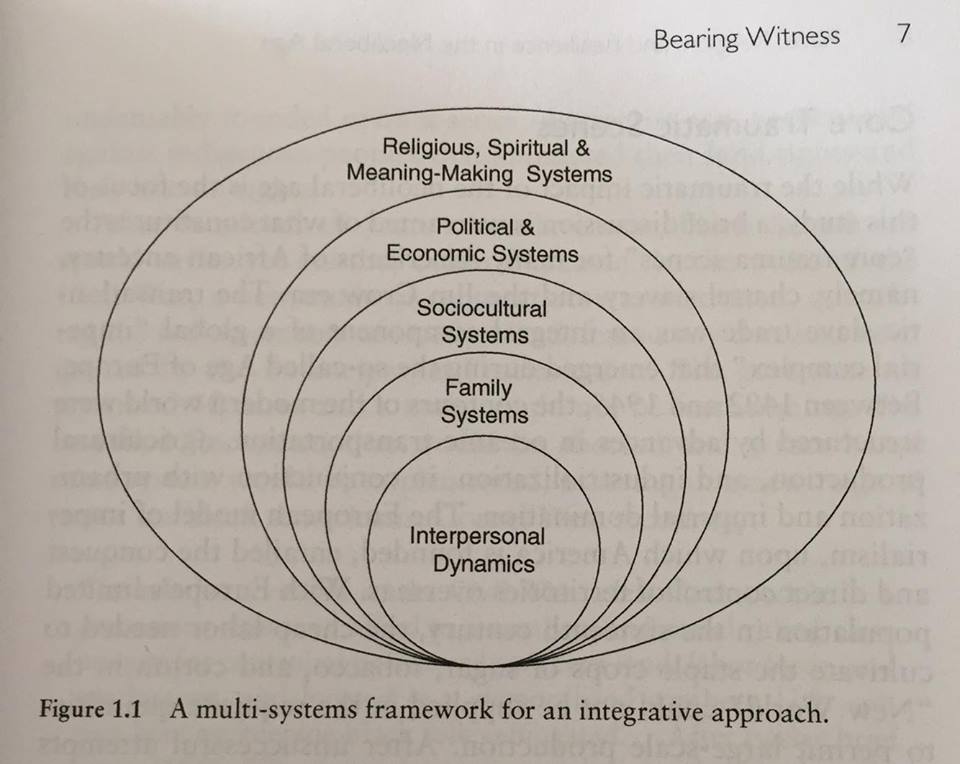
Dr. Cedric C. Johnson, in his book Race, Religion, and Resilience in the Neoliberal Age, writes about an "integrative approach" to soul care:
An integrative approach argues that understanding human functioning is not possible without comprehending the context in which it is formed as a subsystem within a matrix of interlocking historically situated systems. It entails assessing interpersonal dynamics, family systems, sociocultural systems outside the family, economic and political systems, as well as religious, spiritual, or other meaning-making systems. An integrative approach considers the potential influence these systems may have on those who come for care. It thus requires one to "think systems" at all times, even if the practitioner of care is seeing only one member of a family. Strategies for care are derived from an ongoing assessment of where and how to intervene, whether the practitioner is addressing interpersonal dynamics, family dynamics, or the larger systems within which the person or group exists (pg. 6).
Maybe that seems like a lot. Never fear! Dr. Johnson provides a helpful graphic:

From Race, Religion, and Resilience in the Neoliberal Age, pg. 7
The behaviors, strengths, and pathologies of an individual are impacted by the multiple systems they operate in, and vice versa.

This, by the way, is true even for folks who really do have a diagnosable mental illness. Here's John Swinton writing in his book Resurrecting the Person: Friendship and the Care of People with Mental Health Problems:
Mental health problems are incredibly complex phenomena that occur to human beings, who are themselves highly complex creatures. Because of this, there can be no such thing as schizophrenia, bipolar disorder, depression, or any other form of mental health problem, apart from the person who is experiencing it....Likewise, there can be no such thing as a person apart from the particular communities within which the person exists.....Mental health problems, rather than being definable in terms of biology or diagnosis, are an ultimately indefinable combination of pathology, personhood, and community; the aspects are inextricably interlinked. If we omit one from our caring equation, we risk misunderstanding the others (pg. 27).
In other words, even for folks who do indeed have a diagnosable mental health challenge, the diagnosis is only one aspect of a complex human, in community, impacted by systems. We can't just say, "X person had a mental illness" as if that explains their behavior or their personhood. It's an oversimplification, and an ineffective and stigmatizing one at that.

So when we're talking about systems, we're talking about the relationships, communities, and broader forces that impact (and are impacted by) the actions of individuals.

Sick Systems

So what are some of the systems whose sickness I think we should be diagnosing in order to prevent horrific acts of mass violence in this country?

Sick systems, not a sick person

Here is a by-no-means complete list:

Toxic Masculinity
The vast majority of acts of mass violence in this country (and, I would venture to guess, throughout the whole damn history of the whole damn globe) are committed by men. Men, particularly white men, commit the majority of mass shootings in the U.S. (here's one source on that). There's a strong correlation between men who commit acts of mass violence and a previous history of domestic violence or abuse against women (again, here's just one source on that). Why? Here's my friend Jay Yoder, writing a month ago:
Masculinity is all the ideas about what being a man means that we’ve decided as a culture are true and important and necessary. So: being a man means being strong, violent, aggressive. Being a man means being in charge. Etc. etc. etc. ....When we demand certain things of someone because of what gender we need them to be, and in the case of manhood, when we punish it with ridicule, shame, violence, degradation, humiliation (see frat rituals, team rituals, etc.), it creates a toxic masculinity that is bound up in and enforced by violence.
When we teach men, and before that, when we teach young boys, that being a man means being dominant, aggressive, and in control, this has consequences. When those young boys grow into men and find out that they can't, in fact, always be strong, always be in control, always win, this has consequences. Violent consequences.

White Supremacy, Race, and Racism
As already noted, mass shootings in the U.S. correlate not just with masculinity but, more often than not, with white masculinity. I've already written about white supremacy and violence after being in Charlottesville in August. My friend Alicia Crosby offers this definition of white supremacy, which stretches beyond the overt white nationalism of neo-Nazis and KKK members:
White supremacy establishes whiteness as superior to other racial identities through the elevation of the needs, wants, concerns, perspectives, feelings, and desires of white people over that of people of color. This includes the centering of the theological, rhetorical, aesthetic, and economic priorities and preferences rooted in whiteness as well as the appropriation and rebranding of cultural expressions sourced from people of color.
To this, I'd add that white supremacy teaches white people that we deserve to succeed, that we deserve to be in charge, that we are supposed to be the most successful and most important and the peak of civilization.

And then we aren't.

Then we fail at things, and we lose jobs, and we mess things up, and we're sort of mediocre most of the time just like most other people are, and because we've been taught (often subconsciously, sometimes overtly) that by virtue of the color of our skins we are supposed to be superior, and we don't feel very superior at all, we experience this unnamed type of shame. Stir that in with toxic masculinity and violence very quickly becomes a way to re-assert this felt need for control, for success, for extra-ordinary-ness, that is falsely promised to us by white supremacy. Which makes young white men susceptible not only to individual acts of violence, but to intentional radicalization and recruitment.

Radicalization and Recruitment in the Neoliberal Age
Here's just one article (from Vox) about the radicalization of white Americans, about how many of the people who are radicalized are perceived as, and experience themselves as, "losers," and how certain extremist groups can take advantage of that. After Charlottesville, my friend Julie Norman wrote in the Washington Post about her research on youth radicalization, drawing connections between her research with youth in the Middle East and North Africa and the Charlottesville attack. Julie and her research collaborator Drew Mikhael wrote:
From our focus groups, youths who were the most susceptible to radical messaging were those who perceived themselves to be politically and/or economically marginalized, resulting in a pervasive sense of purposelessness and lack of hope for the future. However, it was not poor socio-economic status itself that pointed toward susceptibility, but rather a sense of relative deprivation, coupled with feelings of political and/or social exclusion.
So if you've been told that you're supposed to be in control, and successful, and in charge, but instead you feel excluded, or like a failure, or like a loser...well, it's that much easier for you to radicalize yourself on the internet, or to be intentionally radicalized by a particular organization. The folks who are most susceptible to this are the cast-offs of the neoliberal age, the ones who have been promised much but offered little. And so they go looking for something that can provide them meaning, purpose, a sense of superiority or at least of value. Julie and Drew again:
Ideology matters, but not necessarily its core messaging, be it Islamic fundamentalism or white supremacy. Rather, radical groups use religion and ideologies to legitimize grievances, placing themselves as agents of change and promising empowerment and a sense of purpose.
And if you're looking for meaning and purpose and power, in this culture, there's no promise no alluring than the meaning-making power of violence.

A Culture of Violence, or, Violence as Meaning-Making System
Remember Dr. Johnson's handy diagram? The largest circle in the multi-systems model is "Religious, Spiritual, and Meaning-Making Systems." Ideologies such as white supremacy can fill this role; but I'd argue that in our country, violence itself functions as a meaning-making system. We could talk about theologian Walter Wink's work on "redemptive violence" here, or Chris Hedges' excellent book War is a Force that Gives Us Meaning, or any number of other pieces. We could talk here about an entertainment industry that relies on portrayals of violence to make sales. In a culture of violence, enactments of violence promise meaning, purpose, and power, obscuring the fact that violence gives none of those things. It just gives injury and death.

Gun Companies and War Profiteering
Of course, all of these factors are exacerbated and made more deadly by the ready availability of guns. Groups like Moms Demand Action and Everytown for Gun Safety lobby for legislative changes, which is important; but of course, the biggest obstacle they face is the big money available from the gun lobby and, behind that, from gun companies. The biggest guns in the room, literally and figuratively, are corporations that make billions off of selling weapons. And you know who the biggest buyer of weapons from private companies is? Why, the U.S. government. We've normalized war profiteering in this country. How are gun companies that sell personal firearms doing anything different than what the military industrial complex has been promoting on a massive, hundreds-of-billions-of-dollars scale? These are big, big, money making industries that make donations to political campaigns and lobby members of Congress. What's a few dozen dead church members or concertgoers against trillions of dollars?

The Stigmatizing and Scapegoating of Mental Illness
I wrote already in the previous post about the inaccurate representation of people with mental illnesses as violent. But I'd add to that, here, and say that the stigmatizing scapegoating of people with mental illnesses is itself an aspect of the violent systems at play in mass shootings. For one thing, people who genuinely do have a mental illness are discouraged from seeking help and sharing their pain by the stigma. For another thing, mental illness provides an easy scapegoat and a "pretend" response to violence -- we can easily talk about the invisible thing that is mental health, not do anything about it, and allow the violence to continue while patting ourselves on the back about our statements. How many people who talked about mental health after the Las Vegas shooting have genuinely rolled up their sleeves and gotten to work to fix the mental health care system in this country in the month since? Very few, I suspect. And of course, we then have a whole other set of overlapping systems we could talk about an analyze as far as mental health care in this country: insurance companies, pharmaceutical companies, national legislation, lack of mental health parity, and more.

Multiple Systems Are Always at Play...So What Do We Do?

As I've already said, this isn't an exhaustive list of the systems at play, nor an exhaustive diagnosis of each of these systems. Multiple systems, visible and invisible, are always at play, impacting and being impacted by the actions of individuals. Which can seem very overwhelming. So, what do we do?

I've written before about self-care in a systems context, and how action at one level of a system affects the other component parts of a system. Remember Dr. Cedric C. Johnson's words: "Strategies for care are derived from an ongoing assessment of where and how to intervene, whether the practitioner is addressing interpersonal dynamics, family dynamics, or the larger systems within which the person or group exists" (Race, Religion, and Resilience, pg. 6-7, emphasis added). And Dr. John Swinton's words: "Mental health problems, rather than being definable in terms of biology or diagnosis, are an ultimately indefinable combination of pathology, personhood, and community; the aspects are inextricably interlinked. If we omit one from our caring equation, we risk misunderstanding the others" (Resurrecting the Person, pg. 27).

So. We think systems. We look at the many different systems impacting a particular person or situation, knowing that we might be missing things, that we probably can't understand the whole picture with 100% accuracy. And then we choose where to intervene, where to put energy, where to try to affect the system, while being mindful of the intersections and interactions between our interventions and other parts of the system.

Which means, if you want to advocate for better mental health care....please do!!!! I do. It's a big part of what I do.

But keep in mind the broader contexts. Look at how race and gender, how racism and sexism, impacts mental health. Understand how associating mental illness with violence re-inscribes stigma (see Part I of this blog post for more on that). Think systems, choose an intervention, act, look at the system again.

Mental illness isn't violence. But our systems do create a lot of violence, and our conversation about mental health and mental healthcare in this country ought to include an analysis of the many systems that impact an individual who is struggling with mental health.

A Quick Note on Thoughts and Prayers

Recently, after acts of mass violence in this country, a weird sort of internet debate has inevitably swirled around the appropriateness (or lack thereof) of offering "thoughts and prayers."

Obviously, a big part of this is just a reaction to the hypocrisy of "leaders" who take money from gun lobbyists and refuse to take any real action against gun violence. From these leaders, "thoughts and prayers" does indeed sound like an empty phrase, the useless clanging of a gong.

After the most recent shooting in Texas, this weird debate was even more pronounced because the shooting happened in a church while people were praying and worshipping.

I've already written a bit in a previous post about how I understand the role of prayer in response to violence -- how it's an act of intentional compassion and solidarity that leads to action just as action itself is a form prayer.

So let me just add to that by saying: by all mean, send thoughts and send prayers.

Send prayers by extending real compassion to the people who have been hurt and killed.

Pray for the wisdom and the insight to know how to respond responsibly.

And think. Put your mind to work. Think systems. Think about the multiple factors that impact a person to lead them to violence. And think carefully and prayerfully -- what the Christian tradition has referred to as "discernment" -- about how you, too, and the communities you inhabit, are impacted by and in turn can impact those systems.

Thoughts and prayers? Yes, by all means -- we will need both. Actions? Yes, those too.

Putting them all together?

That's thinking systems.

That's the kind of thing that might just lead us to properly diagnose this problem. And maybe, just maybe, find a cure.

Tuesday, October 10, 2017

Mental Illness Isn't Violence (But Our Systems Sure Are Sick), Pt. I

I have been trying to write this post for more than a week now. It's been a very difficult one to write. And then it was getting very long. So, I have divided it into two posts. Part I looks at the inaccurate public perception of a connection between mental illness and mass violence. Part II looks more closely at systems.

Even as I share this post, I am mindful of the fact that for those directly affected by violence, no think piece and no blog post can address the pain they are going through. For a lot of people, the world feels like it has ended right now. Let's try to honor that with our words, our reflection, and our action.
---

First, here is how it goes for me.

I hear the news, or see it in that early morning social media check that I keep telling myself I should stop doing.

“Oh, no,” I say, softly, to myself.

I try to stop for a second, before I react, before I think. It rarely works, but I try. I try to just shut up for a second. To extend some empathy, some compassion out into the universe. I try to imagine the unimaginable. I try to feel, just for a moment, some of the terror that the people on the scene must have felt. It is a vain attempt, of course. I try, and fail, anyway.

“There’s been another one.” How terrible to be able to say that, “another one.” Another name, another place, in the litany of mass shootings in this country. “Another one.” How blasphemous that we keep saying that. How horrific.

“The deadliest.” We say that again, too. Of course, it’s only true if we ignore other horrors, other massacres whose blood is still dried on our hands. But even if we add some qualifiers, I wish we’d stop saying “the deadliest.” Every bullet that invades a fleshly home, that kicks down the doors of skin to stop a heart and break countless more. Every sacrifice to this false God is the deadliest for someone,
some family,
some child,
some friend.

The deadliest, the deadliest. Who cares about the number when the blood is still drying on the pavement? That day, whatever day it was, whether children, or Bible-studying elders, or concertgoers, that day the clocks stopped for someone for whom that day will always be the deadliest.

The deadliest. I react to that.

And then I wait.

And I don’t usually have to wait long. To be informed by some “source” or another that --
Since this killer was white
And a male
And we can find no way to blame his violence on people we are killing in much larger numbers than this latest massacre --
then
surely
he must be insane.

"Mentally ill," they say, as if using medical language makes the insinuation feel less like a knife in my already twisted gut.

And I breathe in sharply. And the tension rises in my chest. And I let myself feel the hurt in my body. In my bones where, I imagine, I can still feel my sickness, even though it hurts me less right now, scares me less. Just for a moment. Just for a moment.

Hold the silence.
Breathe in.
Breathe out.
Breathe in.
Speak.


I have a mental illness. That's something you likely know, if you've been on this page before. If not, that's ok, I'll name it again. I have bipolar disorder. Type II, if you're into those kind of details. This does not make me statistically more likely to commit a violent act than anyone else (and not just because I'm an aspiring pacifist). According to the U.S. Department of Health and Human Services, only 3-5% of violent acts can be attributed to people with serious mental illnesses. The same source reports that people with severe mental illness are more than 10 times more likely to be victims of violent crime than other folks. Here's the link, if you're curious. And yet, according to researchers from Johns Hopkins, more than one out of two articles on popular news sites that mention mental illness also mention violence, fueling (and being fueled by) a public perception that mental illness correlates with violence. I've seen this correlation play out personally: at my seminary, after students pushed the administration to provide more resources related to mental health and mental illness, one of the first responses of the administration was to provide training for RAs on dealing with someone with a mental illness who, you guessed it, was acting violently. Despite the inaccuracy of this perception, and its stigmatizing nature, it's proven to have a lot of staying power.

There's a few important clarifications to make about this general information. One is just that there's really not one thing called "mental illness" -- there's a bunch of different diagnoses, which in turn are based on a bunch of different presenting symptoms. In my book, which is coming out soon, I write about diagnoses as stories we tell to make sense of human experiences, an idea some people might be surprised to learn I got from one of my psychiatrists. But anyway. Some of these particular diagnoses do include as particular symptoms feelings or urges or compulsions toward violence. This is really important to acknowledge, because these types of feelings can be super scary, and silence and stigma around them can keep people from seeking help.

When I admitted myself into the hospital back in 2011, I was asked several times during the admissions process if I felt like I wanted to hurt myself (I most certainly did, which is why I was there) and if I wanted to hurt anyone else (I did not, though I made a snarky remark about my internet service provider). Those questions are standard because mental health struggles can sometimes include these kind of thoughts. In my case, these compulsions were (and are, though now I've got much better coping tools) directed toward myself. That's not the case for everyone. These kind of urges and compulsions are very scary for people. They're called "intrusive thoughts" because that's just what they do: intrude, invade even, a mind that does not want them there. If you or someone you know is having scary, intrusive thoughts like that, reach out for help. There are a few resources in the sidebar; you can always email me if you need more. 

But having intrusive thoughts is not the same thing as going out and buying dozens of firearms and then meticulously planning a mass shooting. And while some mass shootings have been carried out by people with mental illnesses, since mental illness is actually relatively common in the general population (about 1 in 5 people have some form of diagnosable mental illness at some point in their lifetime), the number isn't really statistically significant.

Do you know what is statistically significant in these cases?

White men with guns. That's what's statistically significant.

We'll get back to that.

Another important clarification I want to make here involves a sort of instinct or gut feeling that people have when such a shooting occurs, which is articulated sort of like this: "Whether or not this person had some sort of diagnosis or not, surely a mentally healthy person would not do something like this?" There's a certain logic to this--shouldn't being willing to shoot hundreds of people in and of itself constitute some sort of unhealthy mindset?

There are problems with this reasoning. For one thing, it's a circular argument: if you define "willing to commit violence" as a mental health problem, then ta-da, every act of violence is committed by someone with a mental health problem. The premise supports itself. It's begging the question.

More important than that, though, the actual effect such reasoning has is to (a) stigmatize those with mental illness, (b) give us an easy out from having difficult conversations about guns, (c) dodge all the other issues involved such as toxic masculinity and white supremacy, all while (d) not actually helping people with mental health issues, because -- and this is important -- if we only bring up the brokenness of this country's mental health care system after a shooting, we make zero progress and just reinforce the stigma that prevents us from making progress in the first place. 

Image from "Mind Your Mind"

But -- and here's the clarification, which gets us, I think, closer to the crux of the matter -- there's some wisdom in wanting to name mass violence as a mentally (and emotionally and spiritually, not to mention physically) unhealthy thing. If we want to talk about violence as form of illness, a form of dis-ease, that's fine. Let's talk about it. It's just that mental illness, which deals with an individual's struggle with experiences that prevent them from functioning the way they want to function, is exactly the wrong category for such a naming. Rather, violence represents a systemic un-health, an interaction between an individual and larger forces that are harmful, that are in-and-of-themselves violent. Paul called them "the powers and principalities."

Such unhealthy systems do very much impact our health, mental, physical, emotional, and spiritual. But that doesn't mean they can be diagnosed by pathologizing an individual's violent actions.

Mental illness isn't violence. But violence might well be an illness, and a systemic one at that. We've got some very sick systems that we're operating in and amongst, and perhaps they are indeed in need of diagnoses. 

---

Part II of this post will look at a systems perspective and examine some of the systems that are at play in 'diagnosing' violence.


Monday, October 2, 2017

Spirituality and Solidarity ( a re-post because I don't have new words)

I originally shared this while I was working at American University, after a string of attacks around the world and bias incidents on campus. (You can see the archived original here.) I don't have any new words right now, for Las Vegas or for Puerto Rico or for Saint Louis or for Georgetown, so I'm posting it with some modifications. Some places you can take action: Moms Demand Action for Gun Sense ; ADAPT National ; Help Puerto Rico ; Campaign Zero

---

Dear friends,

My heart is heavy today. News of violent attacks and the devastation of climate disasters have left us in a state of shock and mourning. Here on campus at Georgetown, we are reeling from a string of racist, sexist, and anti-Semitic graffiti. This all just in the past week or two. Not to mention that we have yet to truly reckon with the trauma of Charlottesville, or yet another police officer acquitted for the shooting of an unarmed black man. Not to mention all of the many places in this world where hatred and division seem to be winning out over love and peace.

The news of tragedy mounts, and it can feel paralyzing. What can we do in the face of such violence? How can we respond?

Of course, we pray. We join together in prayer for all victims of violence and for all those mourning the dead. We pray for peace and for justice. We pray that God will stir up in us a concern for our common humanity and a love for neighbor, even a love for those who would declare themselves our enemies. We take a moment to intentionally extend our compassion to those in pain, even and especially because many of them are strangers to us.

But is this enough? Is it enough to pray, or is more called for?

In one sense, no — prayer is not enough. Action is needed. But in another sense — yes, prayer is enough. For Christians, the spirituality that we express in prayer is an orientation toward and a communion with Jesus Christ. And this Jesus to whom we pray is called Emmanuel, “God with us.” This Jesus stands in solidarity with all those who are victimized and oppressed, all those who are hurting and mourning, all those who are afflicted and sorely pressed. When we read the story of the Crucifixion, we are reminded that in Christ God stands in solidarity even with those feel forsaken or abandoned by God.

When we pray, we open ourselves up to the movement of the Spirit of Christ, which is always the Spirit of solidarity, of reconciliation, and of love in action. Prayer is an expression of solidarity that leads us into further action; and, conversely, our actions of solidarity and advocacy are expressions of prayer.

For those of you who have heard me pray aloud during a worship service, you might have heard me conclude prayers like this: “When we don’t know how to pray, God’s Spirit cries out within us in sighs too deep for words.” I didn’t invent this phrase — it’s just an adaptation of the words of the Apostle Paul, from his letter to the church in Rome: “Likewise, the Spirit helps us in our weakness; for we do not know how to pray as we ought, but that very Spirit intercedes with sighs too deep for words. And God, who searches the heart, knows what is the mind of the Spirit, because the Spirit intercedes for the saints according to the will of God.” (Romans 8:26-27, NRSV translation)

Just before these lines, Paul writes of hope in the midst of the suffering of creation: “We know that the whole creation has been groaning in labor pains until now; and not only the creation, but we ourselves, who have the first fruits of the Spirit, groan inwardly while we wait for adoption, the redemption of our bodies. For by hope we were saved. Now hope that is seen is not hope. For who hopes for what is seen? But if we hope for what we do not see, we wait for it with patience.” (Romans 8:22-25)

All creation is groaning with strife. This morning, this past week, this past month, we’ve heard those groans in a most loud and painful way. And in the face of division and tragedy, it is often difficult to know how to pray, much less what else can be done. Yet Paul links the groaning of creation in the midst of suffering with the groaning of our own hearts in prayer. When we join together in prayer for those who are hurting, we link ourselves to the cries of creation and find ourselves, there, in the heart of God. Prayer links us to Christ in solidarity with the groaning of creation.

Prayer is solidarity. And solidarity is prayer.

One of the central tasks of the Christian community is to proclaim good news — and it is difficult, sometimes seemingly impossible, to do so when faced with such a proliferation of tragic news. Yet I am reminded, today, of the Apostle Paul’s words — that in the midst of the suffering of creation, there is something being born, something being brought to life — the hoped-for redemption, not only of humanity, but of the cosmos.

And so we pray, and we act. In the words of pastor and hymn writer Fred Kaan: “For the healing of the nations, Lord, we pray with one accord; for a just and equal sharing of the things that earth affords; to a life in of love and action help us rise and pledge our word.”

May our prayers join together with the prayers of the world, with the groaning of creation, and lead us out into the world as a sign of solidarity and love in action. And as we go into the world, may we be reminded of Jesus’ promise to us, as written in the conclusion of Matthew’s gospel:

“Look, I myself will be with you every day until the end of this present age.”

Grace and peace be with us all.

Thursday, August 17, 2017

Charlottesville, Supremacy, and What's In Our Eyes

"The eye is the lamp of the body. So, if your eye is healthy, your whole body will be full of light; but if your eye is unhealthy, your whole body will be full of darkness. If then the light in you is darkness, how great is the darkness!" -- Jesus, in Matthew 6:22-23

"Why do you see the speck in your neighbor's eye, but do not notice the log in your own eye? Or how can you say to your neighbor, 'Let me take the speck out of your eye,' while the log is in your eye? You hypocrite, first take the log out of your own eye, and then you will see clearly to take the speck out of your neighbor's eye." -- Jesus, in Matthew 7:3-5

---

I'm still not sure whether I should write something about Charlottesville.

For one thing, Leigh has already written about our experience of the day, which you can read here. She says powerfully most of what I can think to say about the day, other than the one or two times when we were in separate areas and thus have separate accounts. We were there in response to the call from Congregate Charlottesville -- their website is here, and you can read an article about their organizing here.

For another thing, I've been hesitant to write because I think my voice is about the last one that needs to be centered or amplified at this moment. White, cisgender, male, hetero, Protestant Christian -- all the markers of my identity mean that, at least on the surface, I have much more in common with the armed extremists who descended on Charlottesville last weekend than I do with the communities the marchers' chants and weapons targeted. There's a very good reason that the church where we volunteered that day took extra precautions with me, searching me before marking my hand with a green Sharpie heart: physically, there was little to distinguish me from some of the white nationalists marching that day. I could have disappeared into the crowd.

So we need to be listening to women of color right now, to trans and queer folk, to Jews and Muslims. With that in mind, here are a few voices other than mine that I'd ask you listen to first, before you listen to mine:

-- Interview w/Rev. Traci Blackmon of the UCC, Dr. Cornel West, and Dr. Jalane Schmidt, all of whom were in Charlottesville
-- Dr. Robyn Henderson-Espinoza reflects from Charlottesville on what pastoral care looks like after this weekend's violence
-- Lisa Sharon Harper of Sojourners asks if America is willing to pick up its cross
-- The Center for Inclusivity, co-founded by my friend and colleague Alicia Crosby, shares words for people of color; people with other marginalized identities; and allies and accomplices searching for collective liberations
-- My chaplain colleague here at Georgetown, Rev. Rondesia Jarrett Schell, offers a brief and powerful reflection on her reaction to the events in Charlottesville, and calls us to be midwives for the birth of a better world

If you've done all that, and you still want to read what I've written, that's cool. But first, here's 8 suggestions for action from organizers in Charlottesville that you should check out.

[[UPDATE 8/31: Here's a National Call to Conscience from the group we went to support, Congregate Charlottesville, for you to read and sign]]

So. Here's what I've got.

---
Saturday, August 12
---
I recognize their eyes.

I don't have many details about what happened, at least not yet. A car has driven into a crowd of counter-protestors, we assume deliberately, murderously. Now, people are stumbling into the church where we are volunteering, being helped into the medic station or further along the hallway where mental health and trauma specialists are waiting, only to be quickly overwhelmed by the need.

Later, I will see the video, recognize some of the people we talked to, handed water to, gave rides to, tried in some small way to help.

But at this point, I don't know how close they were to the attack, what exactly they saw.

I don't really need to know, though.

I recognize their eyes.

I don't make the connection consciously, not in the moment. But I've seen eyes like that before. In faces covered in the dust of homes destroyed by an occupying military. Or staring blankly at the halls of the psych ward, concealing brains that, for some reason, have decided to turn against themselves.

I think I've probably had those eyes, before. Its hard to know. There's not usually a mirror on hand, and those eyes aren't much interested in checking in on themselves, anyway.

Those eyes have seen something they shouldn't have had to. Those eyes are not seeing the world as an integrated picture, but as a series of fragments, fragments with sharp edges that can cut you if you're not careful, and often even if you are.

Those eyes are what fresh trauma looks like when its reflected in our ocular system. 

---
Today
---

"The eye is the lamp of the body," Jesus says. The way you see the world illuminates or distorts your bodily reality. The white nationals and fascists and literal Nazis who marched through the streets of Charlottesville, I have to believe, have a distorted view of reality, an angry and fearful view clouded by hatred and tinted with lenses of violence. I looked into some of their eyes on Saturday, and was terrified by what I saw. Not surprised. But terrified. I've seen those eyes before, too. The light in them is darkness.

But I'm not thinking about their eyes right now. I'm thinking about the eyes of the people who limped or jogged into the church. I'm wondering what this attack does to their vision of the world. I'm wondering how we care, not just for people's bodies, but for the lamps of their bodies, and for the souls those lamps seek to illuminate.

How do we care for people who have looked through the fragments of a reality that seems whole, have seen beyond it, to something terrifying, and broken, and hurtful.

There are communities, whole communities, whole generations of communities, who have been staring through those violent fragments for a long, long, time. Look close enough, and their eyes tell the story. Their bodies tell the story. Their bodies reflect the reality they have seen through the shards.

---
Saturday, August 12
---

Leigh and I are driving a chaplain to UVA Hospital to care for people being brought in with physical injuries and psychic trauma. On one corner, a group of white nationalists have gathered. Many have their shirts off so that we can see their swastika tattoos. They are armed with guns and clubs. They are chanting, "White Power! White Power! White Power!"

We are at a stop sign, and I cannot avoid making eye contact with them. In a moment of complete surreality, one of them stares at us, then turns to the street, looks both ways, and waves us out into the intersection, as if to say, "It's safe. Go ahead."

It is not safe to be here, not even close to safe, but of course we are white, and our skin disguises our reason for being there. We drive past the group as they continue waving their flags -- Nazi flags and Confederate flags and American flags, all together. I cannot avert my eyes.

---
Today
---


I've been thinking a lot this week about eyes. About those eyes. And about specks and logs in eyes. To be clear, I don't think white nationalism is a "speck" -- it's a hell of a lot more serious than that. We saw a lot of swastikas and a lot of guns and heard a lot of chants of "White Power" on Saturday, and we weren't even in the thick of things. If that's a speck, it's a doozy of a goddamned speck. I use the profanity advisedly and not, I think, in vain.

But it's easy for me to condemn white nationalism. Not easy for people to put their bodies on the line to resist them, but easy to condemn with my keyboard, here in the nice air conditioned student center next to my apartment at Georgetown. Easy to say, "Nazis are bad."

Harder to look at the white supremacist log in my own eye. Harder to see the ways I benefit from systems that advantage folks with my skin color, or with my gender identity, or with my religious beliefs, over other folks. Harder to look in the face unflinchingly at the way this country was built for me and people like me, on the backs and over the spilled blood of black people and brown people. 

I shared this on Facebook already, but I'll share it again here: one role I have at Georgetown is facilitating bystander intervention trainings. During those trainings we do an activity where students collectively arrange different types of behaviors on a spectrum, from "Low Visibility (i.e. tends not to make the news)/High Occurrence" to "High Visibility/Low Occurrence." The activity gets us thinking and talking about the ways that behaviors that are easy to ignore can create the context for more overt interpersonal violence. Positive bystander intervention means not only waiting until the more overt, high visibility end of the spectrum to intervene, but thinking critically about what intervention looks like at the low visibility end of the spectrum.

This graphic communicates a similar idea re: white supremacy. It's not perfect -- I don't know that "socially acceptable/unacceptable" is exactly the right language, especially since there are plenty of social contexts where, for example, racial slurs are considered socially acceptable. (One of the benefits of the spectrum activity is that students discuss why they put different activities on different parts of the spectrum, which can be very illuminating for the whole group.) But it communicates an important idea that is worthy of your consideration. In Charlottesville, we saw overt, (literally) unmasked white supremacy's dangerous, violent face. But we all participate, albeit often unknowingly, in allowing the less overt contexts -- the silent majority -- that lets the overt stuff continue.

All of which is to say: there are things we white people can do, actions we can take, to remove this white supremacist log from our eye, or at least to whittle it down, piece by piece, speck by speck.

So by all means, let us begin. It's far past time we see clearly.

---
Saturday, August 12
---

We are driving home. A few minutes ago, we gave two women, one black, one white, a ride to their car. They, too, have come from D.C. together. One of them has her knee wrapped in a thick bandage. Later, in the video footage, we would recognize her screaming, screaming, screaming. But we don't know, then.

Well, we know. But we don't know.

Perhaps we still do not.

I am driving. Leigh is in the passenger seat. She is looking out the window, but her question is directed to me.

"Where do you think Jesus would have been today?"

I keep my eyes on the road, rapidly blinking tears out of my eyes.

"I don't know," I say. "I don't know."

---
Today
---

I still don't know, not really. Somewhere surprising, I suspect. But I do have some suspicions about where Christ was that day.

The Body of Christ was there in the clergy who sang as they held the line, against tear gas and pepper spray and clubs and hurled insults and death threats.

The Body of Christ was in the churches who opened their doors to those who needed water and medical assistance and a space that was safe, whether they were white or black or brown or Christians or Jews or Muslims or atheist anarchists who would never step into a church on a Sunday.

And the Body of Christ is in the bodies behind those eyes. I believe that with all of my being. I believe that because I've read a story in my Bible in which Jesus asks why God has abandoned him, and those eyes, whether or not the mouths beneath them are familiar with words about God, are asking that same traumatized question.

It has been strange, this week, trying to put the finishing touches on my book about mental illness when my eyes and my body and my heart have wanted to be in Charlottesville. "Why am I writing about this right now?," I've muttered to myself, several times.

But I've kept writing, because the book at its core isn't about mental illness, not really. Here's a quick excerpt from the introduction:
This book emerges from my journey with mental health struggles, but, ultimately, vulnerability is what this book is about. Sharing my story is an exercise in vulnerability. Just as importantly, the images, reflections, and fragments of thoughts about God and faith and ministry that have stumbled their way out of the labyrinth of my personal story are tied together, not by a particular diagnosis, but by the theme of vulnerability. What my story reveals, if it reveals anything at all, are hints of a more vulnerable understanding of God and faith than much of what has been common in the mainstream Christian discourse of our present age. When I look at the Christian story, I see at its center a vulnerable God, a God in tension with the ways we have classically described the divine, a God far too susceptible to suffering and surprise to fit too comfortably into the clothing of omniscience, omnipotence, or omnibenevolence. The God whom I have met along my journey with mental illness, disguised often in a stranger’s face, a community’s embrace, or the long and lonely darkness of a sleepless night, is a God whose vulnerability creates the conditions for solidarity with those struggling, hurting, and wondering why.
That God, I could add, is the one disguised behind those eyes that stare through the fragments of trauma.

And that God, present in weakness and hurt, is the opposite of the God of supremacy--white supremacy or male supremacy or Christian supremacy or supremacy of any other sort you can muster.

That God has no desire to restore some imaginary greatness to our nation or any nation. That God has no interest in such "greatness," because it always has and always will manifest itself in violence to those deemed not-great.

Those eyes. Those eyes have seen what that "greatness" really looks like.

---
Saturday, August 12
---
We are in the church, after the attack on Water Street.

Someone yells, "He's got a gun!"

People begin to panic.

I try not to bolt, try to remain calm, but move with the crowd. Leigh keeps her cool behind me. For a terrifying moment we are separated. I think to myself, "I can't believe I left her behind."

I look around at the frightened people around me as one of the mental health volunteers speaks in a steady but loud voice: "I need everyone to stay calm. I'm going to need everyone to take a breath and calm down."

I look around, and I look into the eyes around me, and I see the fear I am feeling reflected in their eyes.

In those eyes.

The church is on lockdown, but the immediate aggressor has left. I work my way back to Leigh, feeling nothing but shame. She hugs me and whispers, "Non-anxious presence."

Where is Jesus, right now?

In the Spirit, who is breath. In hands that offer healing. And hidden behind those eyes. 

---

"We declare to you what was from the beginning, what we have heard, what we have seen with our eyes, what we have looked at and touched with our hands, concerning the word of life— this life was revealed, and we have seen it and testify to it, and declare to you the eternal life that was with the Father and was revealed to us— we declare to you what we have seen and heard so that you also may have fellowship with us; and truly our fellowship is with the Father and with his Son Jesus Christ." -- John 1:1-3